




















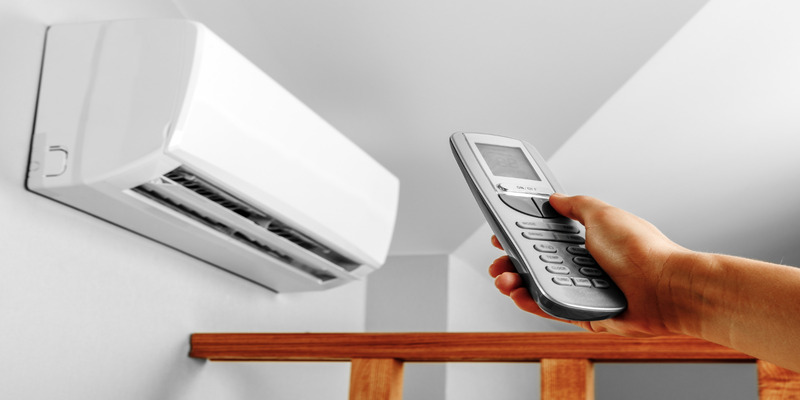
Air conditioning eats roughly a third of your electricity bill during summer. Pick the wrong unit and you'll feel it every time the bill lands. Pick the right one — from a manufacturer that's poured real engineering into efficiency — and the savings compound year after year.
This guide ranks the top 7 AC brands leading on energy performance in 2026, with verified SEER2 ratings, real pricing, and the specific technologies behind each. Every brand here earned its spot for a different reason.
What to Consider Before Choosing an Air Conditioner Brand
The best AC brand for home cooling depends on five things, and they're all connected. A premium unit in the wrong size wastes just as much power as a bargain one.
How SEER2 Ratings Affect Your Electricity Bill
SEER2 replaced the old SEER standard in 2023 with stricter testing that reflects real-world conditions. Federal minimums land at 13.4 SEER2 in northern states and 14.3 SEER2 in the South. But "minimum" and "smart purchase" aren't the same thing. Units in the 18–24 SEER2 range cost more upfront, then pay you back through lower operating costs over a 15-year lifespan. If you're in a hot climate running your AC six months a year, the gap between a 14 and a 21 SEER2 unit shows up fast.
Why Proper Sizing Matters More Than Brand
An oversized AC short-cycles — blasts cold air, shuts off, restarts minutes later. It never runs long enough to strip humidity, and that constant on-off hammering kills the compressor early. Undersized? It runs nonstop and still can't hit your target temp. Both spike your bills. A Manual J load calculation factors in square footage, ceiling height, insulation, window orientation, and local climate. Get the BTU capacity right before you shop brands.
Which System Type Fits Your Home
Central ducted ACs cool the whole house through existing ductwork — Carrier and Trane own this space. Ductless mini-splits give you room-by-room control without ducts, and that's where Daikin, Mitsubishi Electric, and Fujitsu General have the deepest lineups. LG and Samsung play both sides. Figure out your system type first. It cuts the brand list in half.
The R-410A Phase-Out Changes What You Should Buy
The U.S. stopped producing R-410A refrigerant for new equipment in 2025. Manufacturers shifted to R-32 and R-454B — both with lower global warming potential. Daikin moved to R-32 years before most competitors. Mitsubishi adopted R-454B across its current lineup. Buy a unit with next-gen refrigerant now, and you'll have cheaper, easier servicing for the next decade.
Check Dealer Access Before You Fall for Spec Sheets
A 12-year compressor warranty means nothing if no certified tech works within 50 miles of your house. Carrier and Trane have the largest U.S. dealer networks. Mitsubishi and Fujitsu General void warranties on DIY installs — and their contractor coverage varies sharply by region. Look up local installer availability before you commit.
1. Daikin — The Global Efficiency Leader
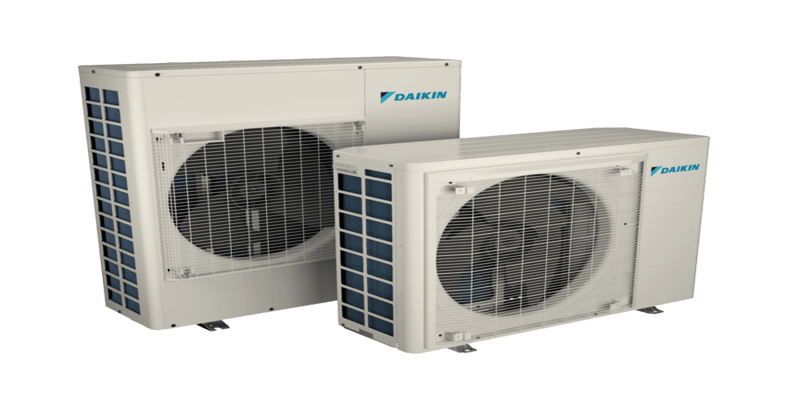 Daikin Industries started building HVAC equipment in Osaka, Japan in 1924 — a full century of heating and cooling behind them. Today, they operate in over 150 countries with 100+ production facilities, making them the world's largest air conditioner brand by volume. They also own Goodman and Amana in the U.S. market, which means Daikin technology quietly runs in millions of American homes that don't carry the Daikin name.
What sets Daikin apart? They manufacture their own compressors and their own refrigerant. That vertical integration gives them control most competitors don't have. They were the first major manufacturer to transition to R-32 refrigerant — years before U.S. regulations forced the industry's hand — and their inverter compressor technology has been refined across four product generations.
Daikin Product Lines and Key Features
- Oterra Series — flagship mini-splits rated up to 21 SEER2 with R-32 refrigerant, titanium apatite photocatalytic air filters, and Blue Fin anti-corrosion coating for coastal climates
- Entra Series — mid-range at 18 SEER2 with the same R-32 platform, ECO+ mode that learns occupancy patterns and cuts consumption by up to 20%
- LV Series — 19.5 SEER2 with lower voltage requirements, suited for older homes with limited electrical capacity. Intelligent Eye sensor reduces output by up to 35% in empty rooms
- FIT Series — compact ducted option at up to 17.5 SEER2, operates as low as 45 dB in quiet mode. Designed for tight installation spaces where standard outdoor units won't fit
- DX9VC/DZ9VC — central ducted systems with variable-speed compressors, up to 19 SEER2, paired with Daikin One+ smart thermostat for full-system optimization
All residential models carry a 12-year unit replacement and 12-year parts warranty through authorized dealers — one of the longest standard warranties in the industry.
Daikin Pricing (U.S. Market)
|
System Type |
Installed Cost Range |
SEER2 |
|
Mini-split (single zone) |
$3,100–$5,300 |
18–21 |
|
Mini-split (multi-zone, 3–4 heads) |
$8,000–$12,000 |
18–21 |
|
Central AC (3-ton typical) |
$5,000–$7,000 |
14.5–19 |
Mini-split equipment alone runs $1,200–$3,500 before installation. Central AC units range from $3,000–$7,000 for the condenser and coil. Prices vary by region, dealer, and whether you're replacing existing equipment or installing fresh.
2. Mitsubishi Electric — The Cold-Climate Specialist
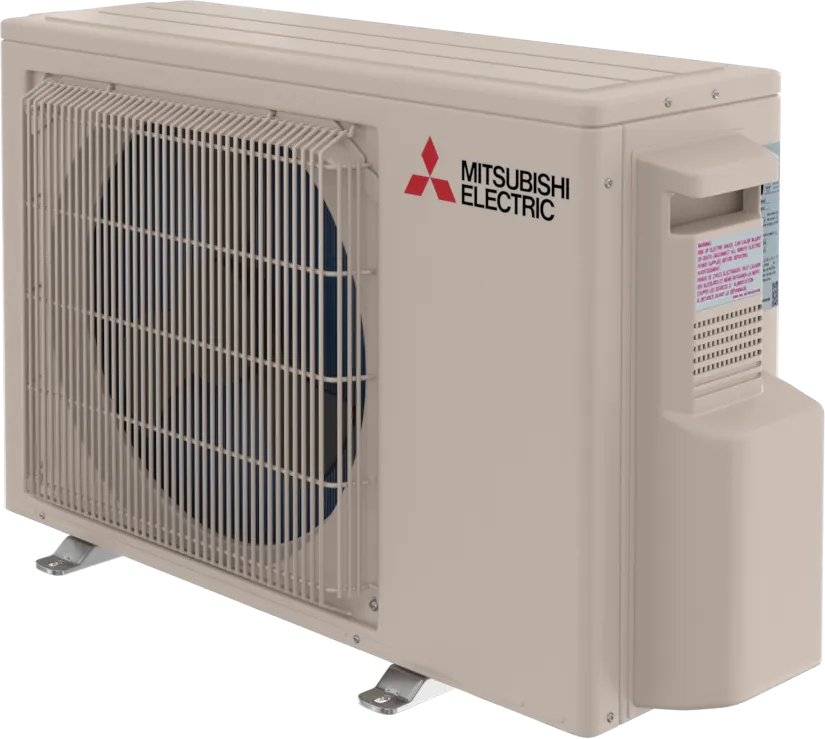 Mitsubishi Electric has built HVAC systems since the 1950s, but the mini-split market is where they've dominated for decades. Headquartered in Tokyo, they're the brand HVAC contractors recommend most often for ductless installations in North America — and the reason usually comes down to one technology: Hyper-Heating.
Their Hyper-Heating INVERTER (H2i) system maintains efficient heat output down to -13°F (-25°C). Standard heat pumps lose capacity fast once outdoor temps drop below 30°F. Mitsubishi's H2i units keep delivering usable heat in conditions that shut competitors down. That's made them the go-to brand in the Northeast, Midwest, and Pacific Northwest, where homeowners want a heat pump that doesn't need a backup furnace.
The 2025–2026 lineup runs entirely on R-454B refrigerant, and their latest FX-Series single-zone unit hits 35 SEER2 — the highest rating of any residential mini-split currently available.
Why Contractors Prefer Mitsubishi
Three things keep Mitsubishi at the top of installer recommendation lists. First, the Kumo cloud app and wireless controllers give homeowners straightforward scheduling and remote access without a separate smart home hub. Second, the indoor units run as low as 19 dB — quieter than a human whisper. Third, the product range covers every indoor unit style: wall-mount, ceiling cassette, floor console, horizontal ducted, and low-wall. Whatever the room layout demands, there's a matching head.
💡 One trade-off to know: Mitsubishi does not sell DIY-install kits. Professional installation by a Diamond Contractor or authorized dealer is mandatory for warranty coverage. That adds cost compared to brands like MRCOOL that market DIY systems, but it also means proper refrigerant charging and commissioning — which directly affects longevity and efficiency.
Mitsubishi Electric Model Tiers and SEER2 Ratings
- FX-Series (premium) — up to 35 SEER2, H2i Hyper-Heating, R-454B. The efficiency ceiling of the residential market right now
- GX-Series (high-efficiency) — 25.6–28.4 SEER2, available in cooling-only and heat pump variants
- EX-Series (mid-range) — 21.7 SEER2, solid all-rounder for moderate climates
- HX/WX-Series (entry) — 18–20 SEER2, budget-friendly with core inverter technology intact
Mitsubishi Pricing (U.S. Market)
Single-zone systems run $3,800–$6,800 installed, depending on the series and capacity (9,000–24,000 BTU). Equipment alone starts around $1,500 for entry-tier and climbs past $3,500 for premium FX units. Multi-zone setups with 3–5 indoor heads typically land between $10,000 and $18,000 fully installed.
Expect a 10-year parts warranty with registration. Some Diamond Contractor dealers extend coverage to 12 years through dealer-backed programs.
3. LG — Dual Inverter Technology Meets Smart Home Integration
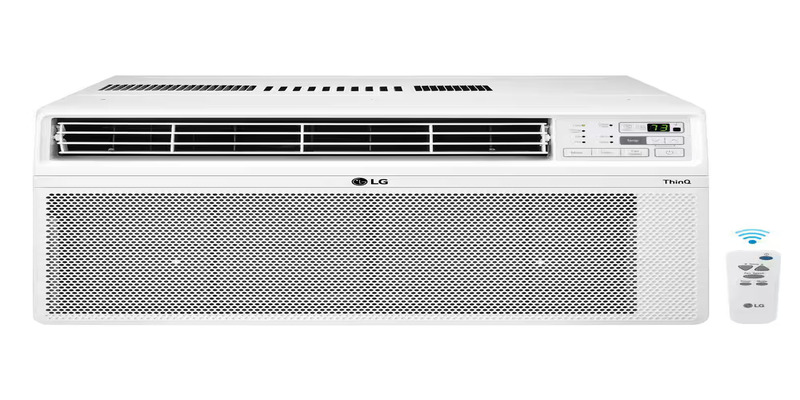 LG Electronics doesn't need an introduction — but their HVAC division often gets overlooked next to their TVs and appliances. That's a mistake. The South Korean manufacturer has been producing air conditioners since 1968, and their residential cooling lineup now spans mini-splits, window units, portables, and commercial VRF systems sold in over 100 countries.
LG's main engineering edge is the Dual Inverter Compressor. Where a standard inverter adjusts speed gradually, LG's dual-rotor design eliminates torque fluctuation during operation. The practical result: faster cooling, lower vibration, quieter performance (some models hit 19 dB indoors), and a compressor backed by a 10-year warranty.
The other half of LG's pitch is ThinQ — their smart home platform. Every current mini-split ships with built-in WiFi. You get app control, voice commands through Alexa and Google Assistant, energy monitoring, and diagnostic alerts pushed to your phone. If you're already running LG appliances at home, ThinQ ties them into one dashboard. No separate hub required.
LG Mini-Split Series Breakdown
|
Series |
SEER2 |
Standout Feature |
Best For |
|
High Efficiency (R-32) |
Up to 25 |
R-32 refrigerant, Gold Fin corrosion protection |
Hot/coastal climates |
|
DUALCOOL |
20–22 |
Dual Inverter, built-in WiFi, 4-speed fan |
General residential use |
|
Mega |
18–18.5 |
Budget-friendly, variable-speed inverter |
Single rooms, tight budgets |
|
Art Cool Gallery |
20–22 |
Customizable front panel — swap in photos or artwork |
Design-conscious spaces |
|
Multi-zone (up to 8 heads) |
20.5–22.5 |
Single outdoor unit serving multiple rooms |
Whole-home ductless |
The Art Cool Gallery line deserves a separate mention. The indoor unit's front panel doubles as a picture frame — you slide in a print, photo, or artwork and the unit blends into your wall. It's a niche feature, but for living rooms and offices where a visible wall-mount bugs you, it solves a real problem without sacrificing performance.
LG Pricing (U.S. Market)
LG positions slightly below Mitsubishi and Daikin on price. Single-zone mini-split equipment runs $1,200–$3,000 depending on capacity and series. Installed costs for a single-zone system typically fall between $3,000 and $5,500. Multi-zone setups with 3–4 indoor units climb to $8,000–$14,000 installed.
Window units and portables sit at the consumer end: $250–$700 for window models, $300–$700 for portables. These carry lower efficiency ratings and suit renters or temporary setups rather than long-term home cooling.
4. Samsung — WindFree Cooling and AI-Driven Efficiency
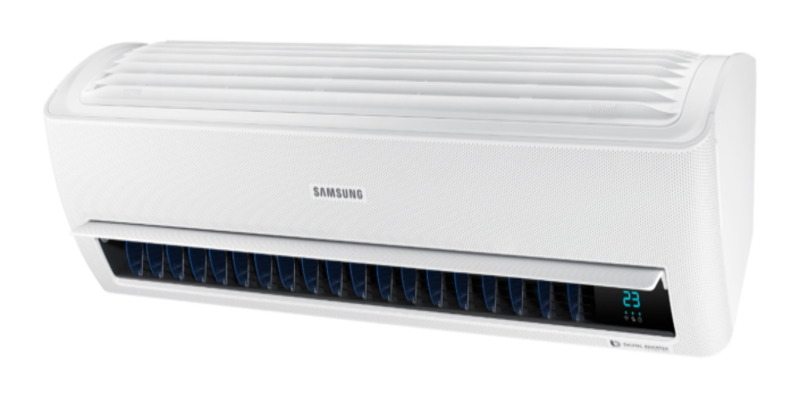 Samsung entered the air conditioning business in 1974 and now ships units to over 100 countries. They're the largest AC brand in India and a major force across Southeast Asia, the Middle East, and Europe. Their U.S. residential HVAC footprint is smaller than LG's but growing — particularly through the WindFree mini-split line and SmartThings ecosystem integration.
Samsung's signature technology is WindFree Cooling. The indoor unit disperses air through 23,000 micro holes in the front panel instead of blowing it from louvers. Air speed drops below 0.15 m/s — what ASHRAE (American Society of Heating, Refrigerating, and Air-Conditioning Engineers) classifies as "still air." You feel the room cooling down without any draft hitting your skin. Samsung claims WindFree mode uses 77% less energy than their fast-cooling mode, though real-world savings depend on room size and setpoint.
Samsung's AI and Smart Features
This is where Samsung separates from the pack:
- AI Auto Cooling — analyzes indoor temperature, outdoor temperature, and your usage history, then switches between fast cooling and WindFree mode automatically. The system gets smarter over time as it learns your patterns
- SmartThings integration — full control through Samsung's smart home platform, including scheduling, energy monitoring, and voice commands via Bixby, Alexa, and Google Assistant
- Wearable Good Sleep mode — links to Galaxy Watch or Galaxy Ring. When the wearable detects you've fallen asleep, the AC shifts to WindFree mode and adjusts temperature through the night
- Freeze Wash — the heat exchanger freezes, then defrosts to wash away dust and 95% of microorganisms. One button, no manual cleaning
Samsung Residential Lineup
Samsung's U.S. residential line centers on three WindFree tiers:
- WindFree Premium — motion detection sensor, highest efficiency, ENERGY STAR certified
- WindFree 3.0e — AI Auto Cooling, Freeze Wash, built-in WiFi, Bixby voice control
- WindFree 2.0e — core WindFree cooling, SmartThings app control, available in 9K–24K BTU single-zone and multi-zone configurations
All models use Digital Inverter compressors with SEER ratings reaching up to 26.5 on select models. Samsung has also started shipping R-32 units globally, though R-410A models still appear in parts of the U.S. market.
Samsung Pricing and Availability
Samsung HVAC pricing in the U.S. is less transparent than competitors because they sell primarily through authorized dealers rather than retail channels. Single-zone WindFree systems generally land between $1,500 and $3,500 for equipment, with installed costs in the $3,500–$6,000 range depending on configuration and region.
❗ Worth noting: Samsung's U.S. dealer network is thinner than Carrier, Trane, or even Mitsubishi. Availability and service support vary significantly by state. If you're considering Samsung, confirm local installer access and parts availability before purchasing. Their products perform well — getting them serviced can be the bottleneck.
5. Carrier — The Brand That Invented Modern Air Conditioning
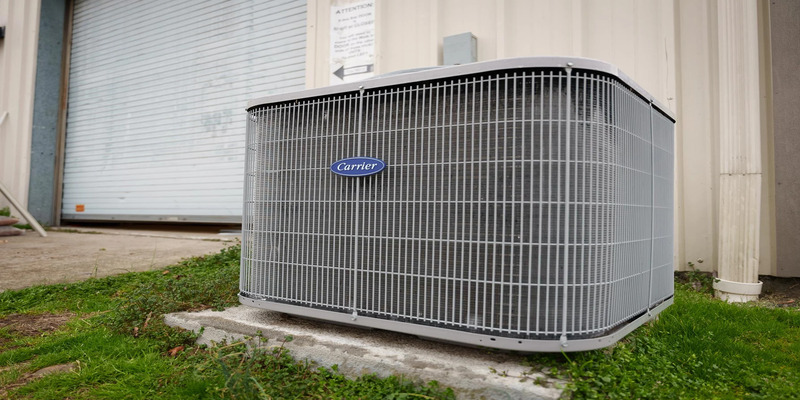 Willis Carrier built the first modern AC system in 1902 for a Brooklyn printing plant that had ink-drying problems. Over 120 years later, the company he founded remains one of the two dominant names in American residential HVAC — alongside Trane. Headquartered in Palm Beach Gardens, Florida, Carrier operates in over 160 countries and maintains the largest dealer network of any air conditioner brand in the United States.
Carrier's residential advantage isn't one flashy technology. It's consistency across the full price range. Their three product tiers (Infinity, Performance, and Comfort) cover everything from budget replacements to flagship variable-speed systems, all backed by the same dealer infrastructure and parts availability. If you have existing ductwork and want a central AC from a brand your local contractor knows inside out, Carrier is the safe bet.
Carrier Product Tiers
|
Series |
SEER2 Rating |
Compressor Type |
Noise Level |
Best For |
|
Infinity 26 (24VNA6) |
Up to 24 |
Variable-speed inverter |
As low as 51 dB |
Maximum efficiency, precise humidity control |
|
Infinity 19VS (24VNA9) |
Up to 19 |
Variable-speed |
~56 dB |
High efficiency in tight installation spaces |
|
Performance 17 (24TPA7) |
Up to 17 |
Two-stage |
~67 dB |
Mid-range comfort, moderate budgets |
|
Performance 16 (24SPA6) |
Up to 16.5 |
Single/two-stage |
Low 70s dB |
Reliable upgrade from older systems |
|
Comfort 16 (24SCA5) |
Up to 16 |
Single-stage |
~72 dB |
Budget-conscious replacements |
The Infinity 26 is Carrier's crown jewel. Its Greenspeed Intelligence pairs a variable-speed compressor with adaptive controls that modulate output between 25% and 100% capacity. Instead of cycling on and off, it runs continuously at low power — keeping temperature within a tight band while stripping humidity more effectively than any single-stage or two-stage unit. It's ENERGY STAR Most Efficient certified and one of the highest-rated central ACs on the market.
Carrier Pricing (U.S. Market)
Carrier central air conditioners run $3,000–$15,000 installed, with most homeowners landing between $4,600 and $8,000. The spread breaks down roughly like this:
- Comfort Series: $3,500–$6,500 installed
- Performance Series: $5,000–$11,500 installed
- Infinity Series: $6,800–$13,500+ installed
All models include a 10-year parts warranty with registration. The Infinity line often qualifies for utility rebates due to its high SEER2 ratings.
6. Fujitsu General — The Quiet Performer Contractors Trust
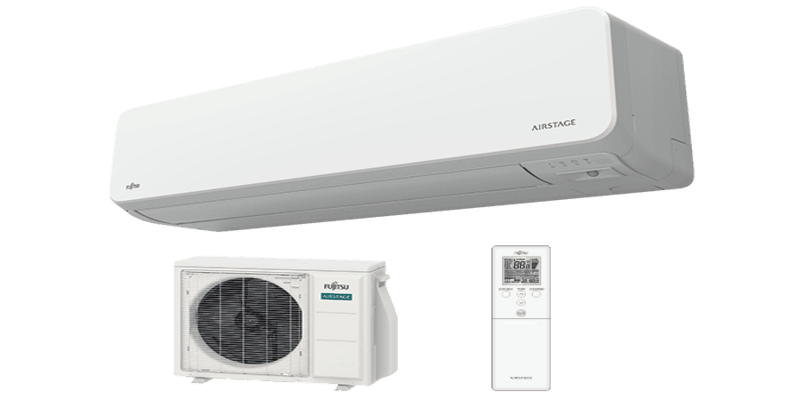 Fujitsu General doesn't run Super Bowl ads or sponsor home renovation shows. Yet ask any HVAC contractor which ductless brand they'd put in their own house, and Fujitsu comes up constantly. The Japanese manufacturer (a subsidiary of the Fujitsu Group, established in 1936) has built a reputation on raw efficiency numbers, cold-climate heating output, and reliability that shows up in low callback rates for installers.
Their residential line recently rebranded from Halcyon to Airstage, though the engineering DNA stayed the same. The standout: Fujitsu's 9,000 BTU single-zone unit hits 33.1 SEER2 — matching or beating anything from Mitsubishi and Daikin at that capacity. Their XLTH (Extra Low Temperature Heating) series maintains heat output down to -15°F, putting it in the same cold-climate conversation as Mitsubishi's H2i technology.
What Makes Fujitsu Different
Most brands lead with smart features and app ecosystems. Fujitsu leads with compressor engineering and system longevity. Three things stand out:
- Highest single-zone efficiency available. The Airstage LZAS1 series reaches 33.1 SEER2 at 9K BTU — one of the top ratings in any residential mini-split on the market
- XLTH cold-climate performance. Full heating capacity maintained well below zero. No backup furnace needed in most northern climates
- Contractor loyalty. Low warranty claim rates and straightforward installation specs make Fujitsu a preferred brand among independent HVAC pros. They don't sell DIY kits — every unit is professionally installed and commissioned
The Airstage mobile app provides remote control, scheduling, and energy tracking. WiFi is built into most current models. Smart home integration covers Alexa and Google Assistant, though Apple HomeKit is not supported natively.
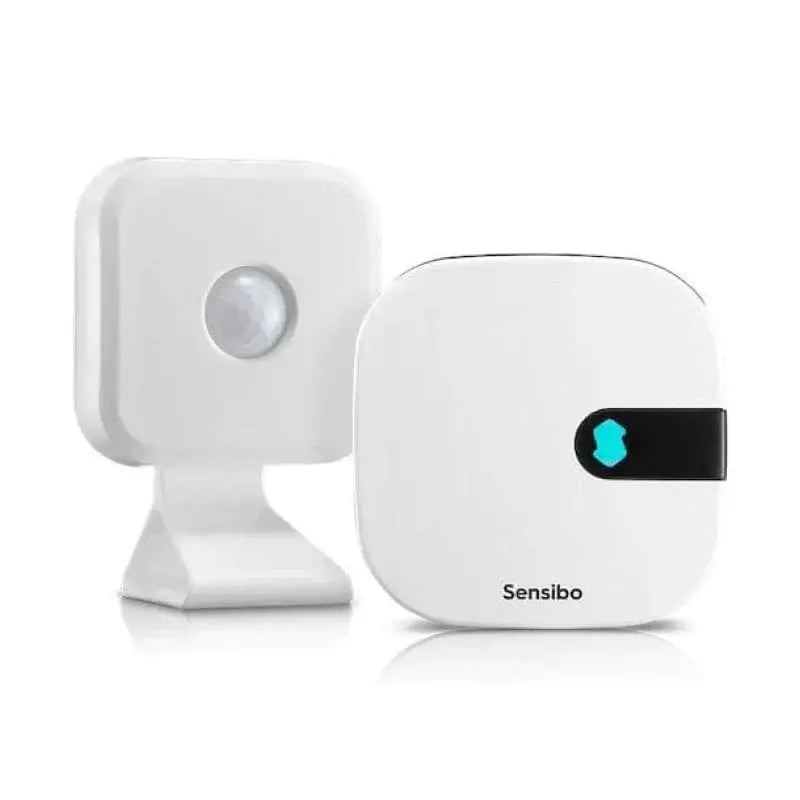
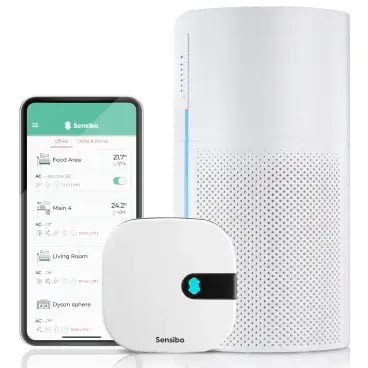
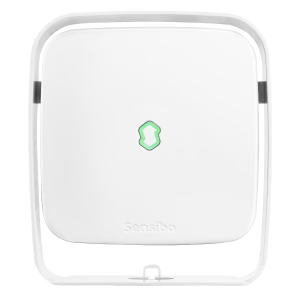
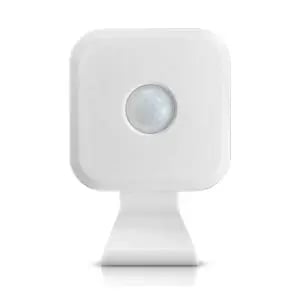
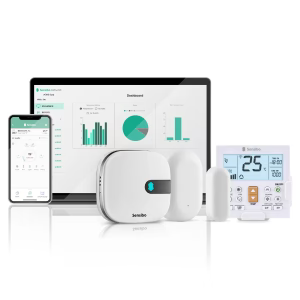
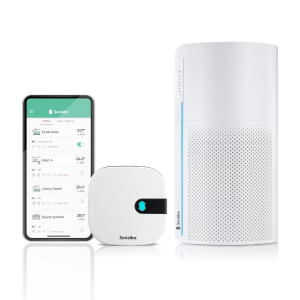
💡 Connection to Sensibo: Fujitsu General partnered with Sensibo in 2023 for the Australian and New Zealand markets, embedding Sensibo's operating system into Fujitsu's anywAiR platform. Customers control their Fujitsu units through both the Fujitsu and Sensibo apps — a signal of how seriously Fujitsu takes software-driven efficiency.
Fujitsu General Pricing (U.S. Market)
Fujitsu prices align closely with Mitsubishi — premium positioning backed by premium specs.
- Single-zone (9K–18K BTU): $3,500–$6,000 installed
- Multi-zone (2–5 heads): $8,000–$16,000 installed
- Entry-tier models (18–20 SEER2): Equipment from $1,200; installed from $3,000
Standard warranty is 10 years on parts with registration. XLTH models qualify for federal energy efficiency incentives where applicable.
7. Trane — Built for Durability in Extreme Conditions
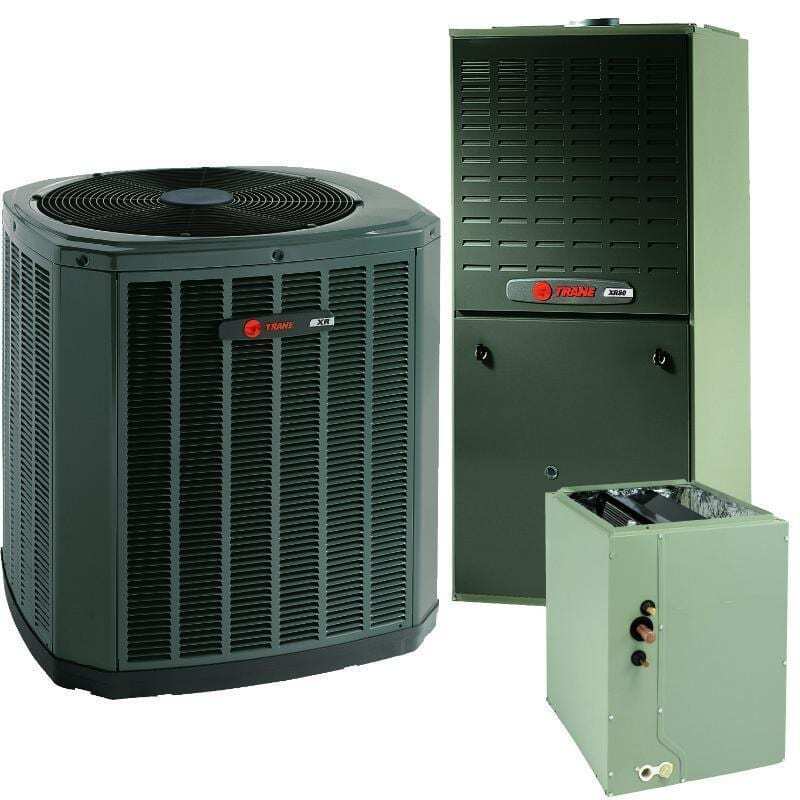 Trane has been manufacturing HVAC equipment since 1913 — 113 years of building systems that take punishment. Headquartered in Davidson, North Carolina, and now a subsidiary of Trane Technologies (formerly Ingersoll Rand), Trane sells through one of the two largest dealer networks in the U.S., neck and neck with Carrier.
Here's what separates Trane from the pack: they torture-test every unit design for 16 consecutive weeks in conditions simulating five years of extreme wear. Rapid temperature swings, sustained high-load operation, corrosive environments, and voltage fluctuations — all before a single unit ships to a dealer. That testing protocol is why Trane's central ACs have a reputation for outlasting competitors by several years, particularly in punishing Southern climates where units run 8+ months per year.
Their product line focuses entirely on ducted central systems and heat pumps. If you're shopping mini-splits, look elsewhere. If you have ductwork and want a central AC that's still running strong in 20 years, Trane belongs on your shortlist.
Trane Product Series
- XV Series (premium) — variable-speed Climatuff compressor, up to 23.6 SEER2, noise levels as low as 55 dB. Integrates with Nexia Home Intelligence for smart scheduling and remote control. The XV20i is Trane's best AC brand offering for homeowners prioritizing both efficiency and longevity
- XL Series (mid-range) — two-stage compressor, up to 18 SEER2. Solid balance between performance and cost. Quieter than entry models and eligible for most utility rebates
- XR Series (entry) — single-stage, up to 16 SEER2. Dependable baseline cooling for moderate climates or budget-first buyers. Still carries Trane's build quality and testing pedigree
All series use Trane's proprietary Climatuff compressor, designed for extended lifespan under continuous heavy loading.
Trane Pricing (U.S. Market)
Trane sits at the premium end of central AC pricing — you're paying for that durability testing and dealer support.
|
Series |
Installed Cost Range |
SEER2 |
|
XR (entry) |
$5,000–$7,000 |
Up to 16 |
|
XL (mid-range) |
$6,000–$8,800 |
Up to 18 |
|
XV (premium) |
$7,500–$14,000 |
Up to 23.6 |
Trane offers a 12-year compressor warranty and 10-year parts warranty with registration — among the strongest coverage in the central AC market. Their Comfort Specialist dealers may extend labor coverage through dealer-backed programs.
Top 7 Air Conditioner Brands in the World (2026)
|
Brand |
Country |
Key Features/Technologies |
Best For |
|
Daikin |
Japan |
R-32 refrigerant pioneer, inverter compressors across all tiers, Intelligent Eye occupancy sensor, 12-year warranty |
Homeowners who want proven Japanese engineering with the broadest global product range |
|
Mitsubishi Electric |
Japan |
Hyper-Heating H2i (operates to -13°F), up to 35 SEER2, 19 dB indoor operation, kumo cloud app |
Cold climates where a heat pump must replace a furnace year-round |
|
LG |
South Korea |
Dual Inverter Compressor, ThinQ smart platform, Art Cool Gallery design units |
Smart home users who want strong WiFi integration and competitive pricing |
|
Samsung |
South Korea |
WindFree 23,000 micro-hole cooling, AI Auto Cooling, SmartThings, Galaxy wearable sleep mode |
Hot-humid regions where draft-free cooling and AI optimization matter most |
|
Carrier |
USA |
Greenspeed Intelligence variable-speed, Infinity/Performance/Comfort tiers, largest U.S. dealer network |
Central ducted homes needing reliable service access and a full range of price points |
|
Fujitsu General |
Japan |
33.1 SEER2 single-zone, XLTH heating to -15°F, Airstage platform, Sensibo software partnership |
Efficiency-first buyers and cold-climate homes wanting top SEER2 without overpaying |
|
Trane |
USA |
16-week extreme-condition testing, Climatuff compressor, up to 23.6 SEER2, 12-year compressor warranty |
Durability-focused homeowners in harsh climates who prioritize lifespan over upfront cost |
Top 7 Air Conditioner Brands in the United States (2026)
|
Brand |
Country |
Key Features/Technologies |
Best For |
|
Carrier |
USA |
Up to 24 SEER2 (Infinity 26), variable-speed Greenspeed, three product tiers, largest dealer network |
Whole-home central AC with easy access to local contractors nationwide |
|
Trane |
USA |
Up to 23.6 SEER2 (XV20i), torture-tested durability, Nexia smart integration, 12-year compressor warranty |
Long-term investment — homeowners who want a central AC built to last 20+ years |
|
Mitsubishi Electric |
Japan |
Up to 35 SEER2 (FX-Series), H2i heating to -13°F, R-454B, Diamond Contractor network |
Ductless mini-splits in cold-climate states (Northeast, Midwest, Pacific Northwest) |
|
Daikin |
Japan |
Up to 21 SEER2 mini-splits, R-32 refrigerant, owns Goodman/Amana, 12-year warranty |
Buyers wanting premium ductless performance or affordable options through Goodman/Amana |
|
Fujitsu General |
Japan |
33.1 SEER2 single-zone, XLTH cold-climate heating, Airstage app, contractor-preferred brand |
Single-zone efficiency leaders and homes needing heat pump performance below 0°F |
|
LG |
South Korea |
Up to 25 SEER2, Dual Inverter, ThinQ app, Art Cool Gallery, multi-zone up to 8 heads |
Budget-to-mid-range ductless with strong smart home connectivity |
|
Samsung |
South Korea |
WindFree draft-free cooling, AI Auto mode, SmartThings, up to 26.5 SEER |
Growing U.S. presence — best for Samsung smart home households, but verify local dealer access |


.jpg?height=200&name=close-up-heat-pump-outside-home%20(2).jpg)