























Every air conditioner sold in the United States comes with a yellow EnergyGuide sticker. On it, you'll find a number. That number is supposed to help you make a smarter purchase. The problem? Most people stare at it, nod, and pick the unit that fits their budget anyway.
That number is an AC efficiency rating, and it tells you how much cooling you get for every watt of electricity the system consumes. Three metrics dominate spec sheets right now. The SEER rating, the EER rating, and the newer SEER2 rating that replaced the original SEER standard in January 2023. Each one measures efficiency under different conditions and applies to different equipment types. Here's what they mean, how they compare, and why the number on the sticker might not match what your system delivers at home.
What Does an AC Efficiency Rating Measure?
An AC efficiency rating expresses the relationship between cooling output and electrical input. The higher the number, the more cooling a unit produces per watt of electricity. A system rated 20 delivers the same cooling as one rated 14 while burning roughly 30% less power.
Think of it like fuel economy. Two cars get you to the same place; one drinks less gas. The SEER rating and SEER2 rating work like combined MPG for central air conditioners, heat pumps, and mini-splits. The EER rating works more like highway MPG at a fixed speed. Central systems carry both numbers; window and portable units rely on EER instead.
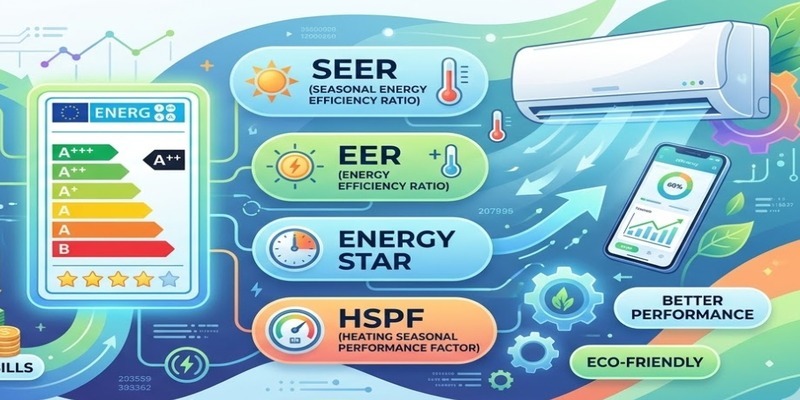 SEER and SEER2: Seasonal Efficiency Across a Full Summer
A SEER rating represents the total cooling output of a system (in BTU) divided by the total electrical energy consumed (in watt-hours) over an entire cooling season. Testing runs across outdoor temperatures from 65°F to 104°F, weighted to reflect a typical U.S. summer.
Your AC doesn't run at full blast every hour of every day. On a mild 72°F morning in May, it barely cycles. On a 98°F July afternoon, it runs hard and long. A SEER rating captures efficiency across that full range, giving you a seasonal average rather than a single-afternoon snapshot. Systems between 13-16 SEER meet federal baseline requirements and suit mild climates or tight budgets. Units in the 17-20 range typically feature variable-speed compressors that modulate output to match the load. Premium systems above 20 SEER use inverter-driven compressors for even greater savings. Upgrading from a SEER 9 unit (common in systems 15-20 years old) to SEER 13 cuts power consumption by roughly 30%.
On January 1, 2023, the Department of Energy retired SEER and replaced it with SEER2 for all newly manufactured residential cooling equipment. The old test didn't reflect reality. Original SEER testing used an external static pressure of just 0.1 inches of water, simulating nearly perfect ductwork. The new M1 testing protocol raised that to 0.5 inches (a fivefold increase) to simulate resistance from real ducts, filters, and registers.
Same physical equipment, tougher test. A unit that earned 16.0 SEER under the old protocol might land at about 15.2 SEER2. The measurement got more honest, not worse. To compare across eras, divide the old SEER number by roughly 1.05 for a close SEER2 equivalent.
The DOE also updated minimum efficiency requirements by region:
|
Region |
Min. SEER2 (split, <45k BTU) |
Old SEER equivalent |
|
North |
13.4 |
~14.0 |
|
Southeast |
14.3 |
~15.0 |
|
Southwest |
14.3 |
~15.0 |
Any central AC or heat pump manufactured after January 1, 2023, must meet these floors. Older equipment already installed can remain in service.
EER: Peak-Day Performance When It's Hottest
 Where SEER averages performance across a season, the EER rating locks in on one scenario. It tests at 95°F outside, 80°F inside, 50% relative humidity, and gives you the ratio of cooling capacity (BTU/h) to electrical input (watts) at that fixed point.
This makes EER the better metric for climates that stay hot for months without relief. If you live in Phoenix and your AC runs 10+ hours a day from May through September near peak load, the EER number tells you more about your real electricity costs than SEER does. In the upper Midwest or Pacific Northwest, where summer temps swing between the 60s and 90s, SEER's seasonal average is more useful.
A rough conversion for typical residential central systems puts EER at around 0.875 times the SEER value. A 16 SEER unit might carry an EER near 14.
Window and portable air conditioners use EER rather than SEER because their single-speed compressors make seasonal testing less meaningful. Since 2014, room units also carry a CEER (Combined Energy Efficiency Ratio) number that adds standby power consumption into the calculation. Central systems manufactured after 2023 list an EER2 figure alongside SEER2, tested under the same updated M1 protocol.
|
SEER / SEER2 |
EER / EER2 |
|
|
Measures |
Seasonal average across 65-104°F |
Single-point efficiency at 95°F |
|
Best for |
Climates with varied summer temps |
Consistently hot climates |
|
Applies to |
Central AC, heat pumps, mini-splits |
All AC types including window units |
Why the Sticker Number Isn't the Whole Story
Every AC efficiency rating on a spec sheet was produced in a controlled laboratory. The system had perfectly sealed connections, correct refrigerant charge, and calibrated airflow across every coil surface. Your house doesn't offer those conditions.
ACCA research dating back to the mid-1990s consistently finds that 70 to 90% of residential cooling systems have at least one installation-related performance issue. Duct leakage alone can dump a third of conditioned air into attics and crawlspaces. Incorrect refrigerant charge, which affects over half of installed systems, degrades efficiency by 5-20%. A system rated at 15.2 SEER2 can perform like a 13 in the field if the installer skipped duct sealing or never verified subcooling and superheat.
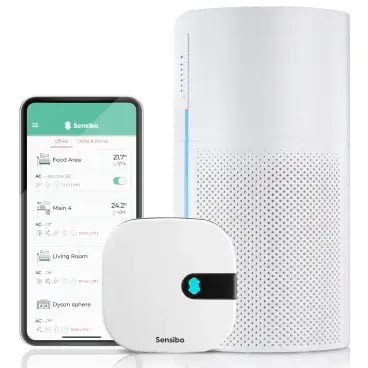
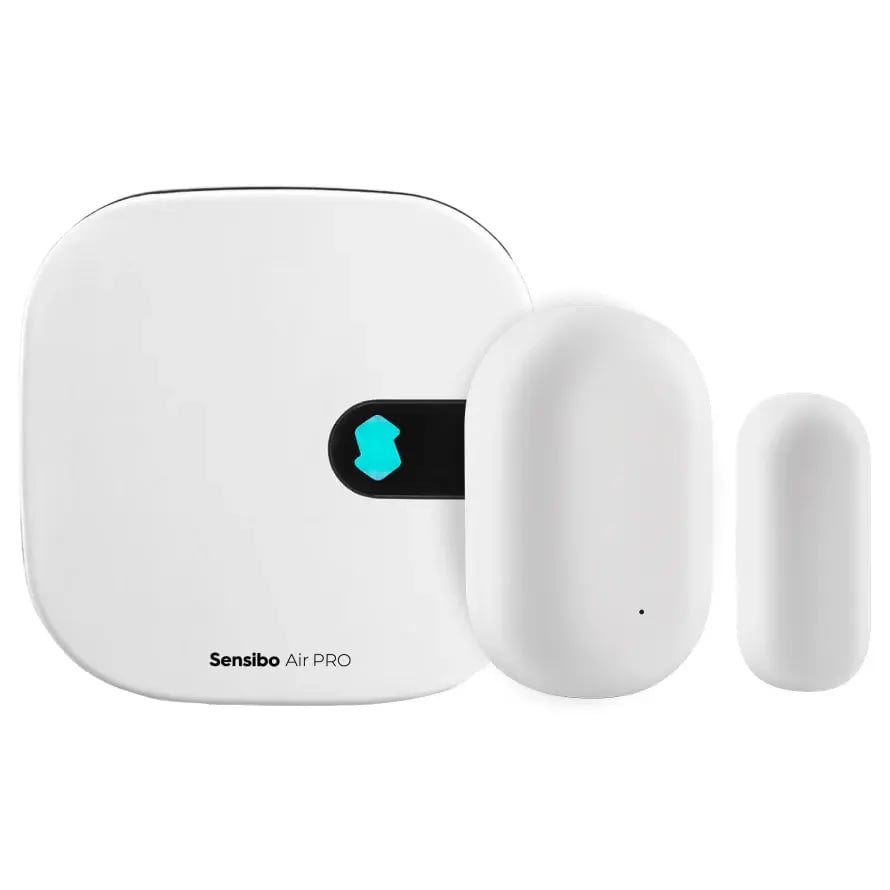
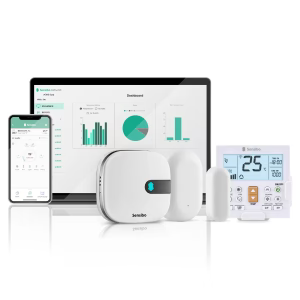
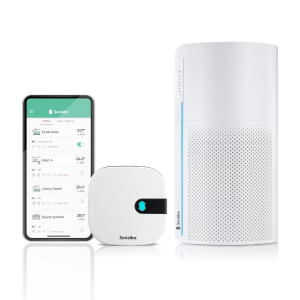
Smart AC controller Sensibo can reduce wasted runtime by optimizing schedules, triggering geofencing-based shutoffs, and cutting unnecessary cycles. But no software fixes a bad line set connection or an undersized return duct. The rating on the sticker is a ceiling, not a guarantee.
 How to Estimate What a Higher Rating Saves You
The formula is simple. Take your AC's cooling capacity in BTU, divide by the SEER2 rating, and you get average watts consumed. Multiply by your runtime hours and local electricity rate, and you have an annual cooling cost.
For a 36,000 BTU system running about 1,000 hours per year at $0.16/kWh, a 14.3 SEER2 unit costs roughly $402 annually to cool. The same system at 18 SEER2 drops that to about $320. That's $82 per year, or around $1,230 over a 15-year equipment lifespan.
If the higher-rated unit costs $1,500 more upfront, it takes roughly 18 years to break even at that usage level. Bump the runtime to 2,000 hours (common in Texas, Florida, or Arizona), and payback shrinks to under 10 years. That's how you turn an AC efficiency rating into a financial decision.

.png?height=200&name=image_2023-11-20_10-40-17%20(1).png)