
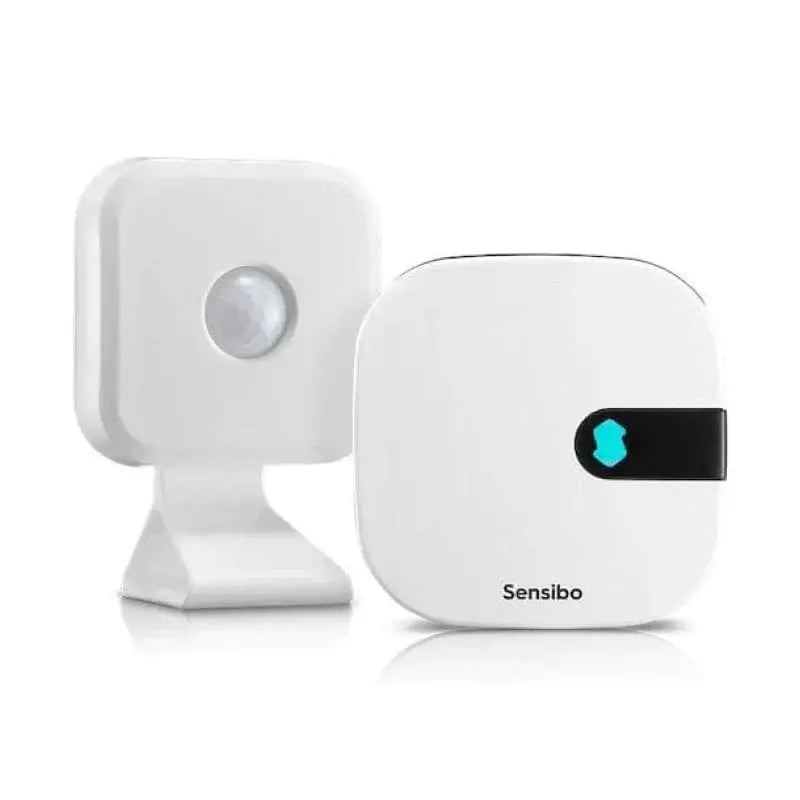




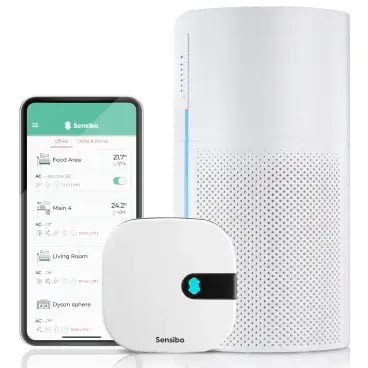







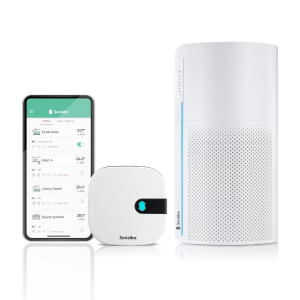
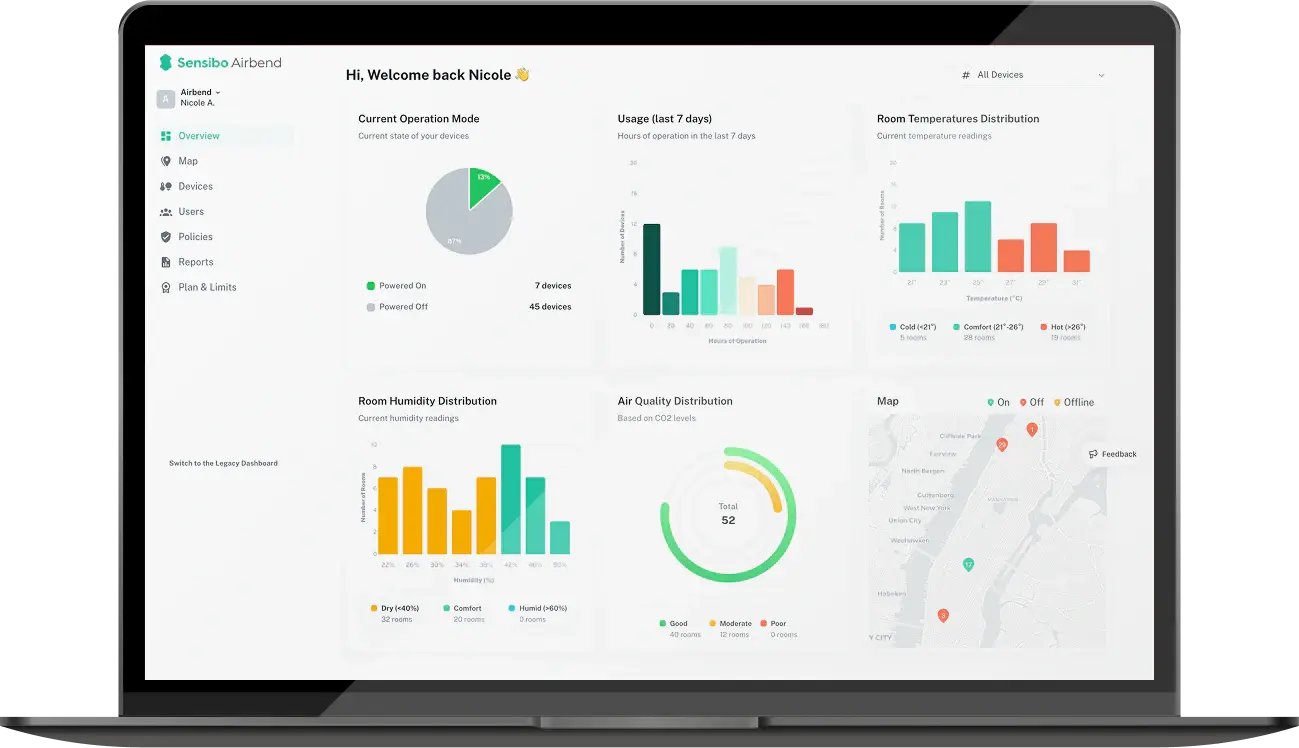










Most "smart HVAC" pitched to hotels is a smart thermostat with a marketing budget. The real version is more useful and more complicated: a system that knows when guests are in the room, what the PMS says about the reservation, what the weather is doing outside, and what the utility is willing to pay for load flexibility.
This guide covers what makes hotel HVAC systems smart in practice, what the peer-reviewed energy savings look like, where vendors are quietly over-promising, and how to tell whether a retrofit is the right call for your property.
What Makes a Hotel HVAC System "Smart"
Smart is a spectrum, not a switch. At the minimum end: a programmable thermostat that happens to connect to WiFi. At the maximum end: a full building management system (BMS) reading thousands of data points from chillers, air handlers, variable-speed drives, and guest-room controllers, all cross-referenced against PMS reservation data and utility pricing signals.
Most hotels neither need nor can justify the top of that stack. The practical sweet spot for mid-scale, upscale, and most upper-upscale properties: in-room smart thermostats with occupancy detection, connected to a centralized energy management platform, with PMS integration on top. That combination is what the industry usually means when it sells you "smart hotel HVAC systems."
A useful checklist to cut through the marketing: does the system detect occupancy, talk to the PMS, expose runtime data, and keep heating or cooling the room if the WiFi drops? The first three are the base layer. The fourth is the one most vendors don't mention until after the demo is over.
Why Hotels Are Making Hotel HVAC Systems Smart Now
Several forces stack.
Energy is the loudest. HVAC eats 40–50% of a hotel's total energy bill, and guest rooms sit unoccupied roughly 60% of the time they're booked. Business hours out of the room. Evenings at dinner. Overnight trips. The dead zone between check-out and the next arrival. The room is cooling nobody. The meter keeps running.
Guest behavior doesn't help. A study of 64,000 hotel room nights found 54% of guests don't turn off the AC when they open windows or doors. The HVAC fights the outdoor air. The utility bill doesn't care why.
Three other forces compound the energy case. Corporate ESG reporting increasingly requires per-room energy data that traditional hotel HVAC systems can't produce. Guest room condition is the #1 weighted dimension in J.D. Power's 2025 hotel satisfaction methodology, and temperature problems are the easiest way to tank a review. And every front-desk call about a hot or cold room pulls housekeeping and engineering time that doesn't get billed back anywhere.
How Smart Hotel HVAC Systems Work Under the Hood
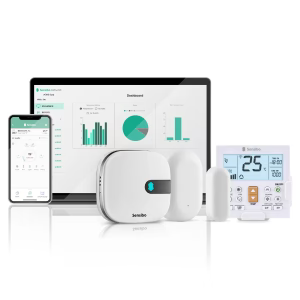
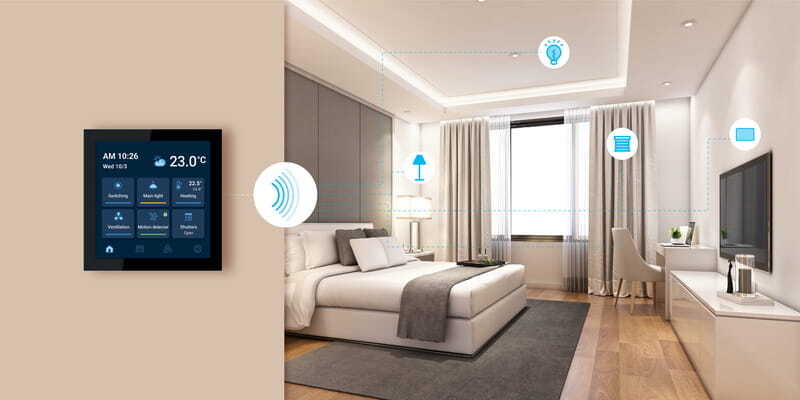
A smart hotel HVAC system is four things stacked: a thermostat in each room, sensors watching occupancy, a dashboard pulling everything together, and a link to the PMS. The value comes from how they talk to each other.
When a guest checks in, the PMS sends a signal. The controller in their room warms or cools to the standard arrival setpoint before they get off the elevator. Inside the room, motion and door sensors watch for activity. Nothing moves for twenty minutes, the thermostat drifts toward setback. The guest comes back, movement (or the door opening) triggers a return to their preferred setpoint. At checkout, the PMS fires another signal and the room drops to a deeper setback until housekeeping or the next arrival.
The engineering side sees all of this on one dashboard. Runtime per room. Current temperature. Alerts when a unit struggles. A fault that used to surface as a guest complaint now surfaces as a line item in a report before anyone gets cold.
Communication between the layers runs on BACnet, Modbus, OPC-UA, or REST APIs, depending on the vintage and vendor mix of your property. Vendors that support all four are easier to work with than vendors locked into one.
The Real Benefits of Smart Hotel HVAC Systems
 Ask three smart HVAC vendors what savings you'll see, and you'll hear three different numbers. A peer-reviewed study hedges the answer with a range wide enough to read like a cop-out. Both are right, and understanding why is the difference between picking the right system and regretting the purchase in year two.
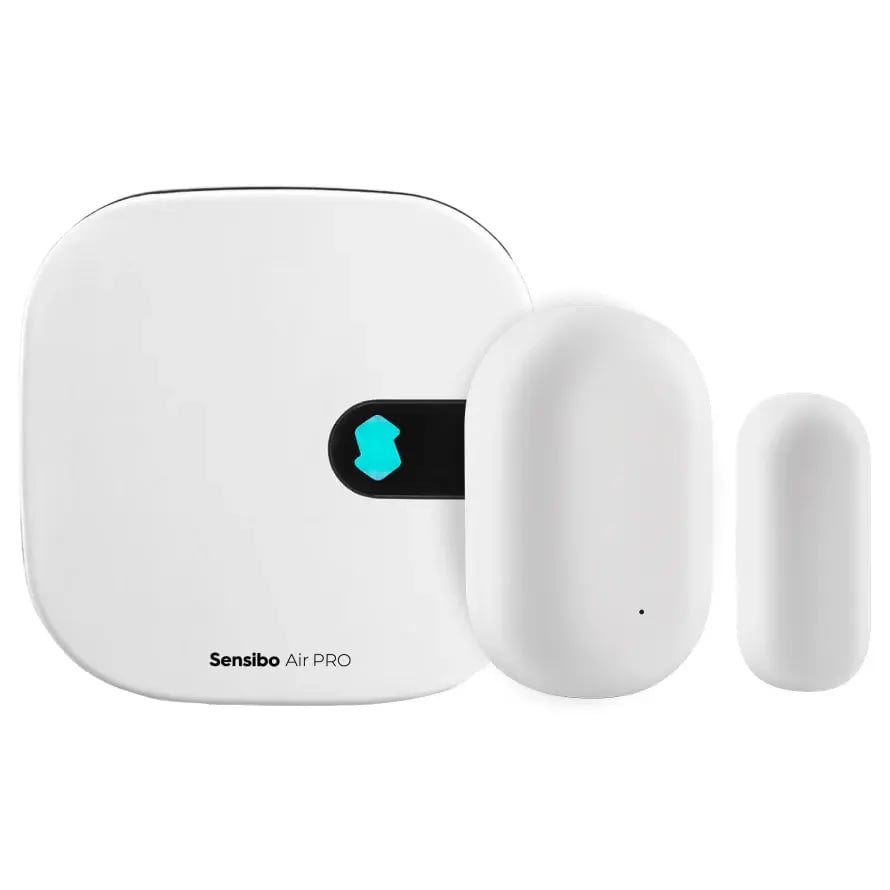
The savings depend less on the technology and more on what you had before. An old Houston hotel running oversized PTACs on 1990s insulation has a lot of waste to capture. A well-insulated new build in San Francisco doesn't. That's why the peer-reviewed range is so wide. Calibrated simulations, US utility field data, and vendor case studies from Sensibo's smart AC management platform for hotels, Verdant, and SensorFlow tell the same story. The technology works. The savings scale with how wasteful your baseline was. Plan for the high teens to mid-20s in year one. Anything above that is upside, not a guarantee.
Energy isn't usually what sells this to the owner. What sells it is that the engineering team stops playing whack-a-mole. A compressor short-cycling shows up as an alert on a Tuesday dashboard, not a Friday service call after three guests have already left early. Temperature complaints, which drag down the satisfaction category J.D. Power weights hardest, get rare enough that the review score starts moving up instead of down. That's the part that wins the spreadsheet meeting. The energy number just gets the meeting booked.
A Question on Smart Hotel HVAC Implementation
Four mistakes show up in most failed rollouts. Each has a documented fix that costs less than the mistake.
Sensor-only occupancy detection will misread your guests
Motion-based sensors apply a simple rule: no movement for the configured interval, room registers as empty. That rule misreads guests who are reading, working at a desk, or asleep. One vendor openly admits the category's most common complaint source is sensor-based thermostats that "can't determine the difference between an absent and a sleeping guest." The cheap fix is at the spec stage: combine motion with door/window sensors and PMS check-in status before signing anything. Multi-signal systems measurably outperform motion-only on complaint rate.
Three audits to run before ordering hardware
Before committing to a spec, walk three checks:
- Room-by-room WiFi signal strength. Marriott's IoT Guestroom Lab pilots found their door locks needed stronger signal than plans allowed, forcing additional access points per floor before property-wide rollout.
- Your PMS version and its API documentation. Older PMS and BMS platforms often lack the API support modern smart thermostat platforms need. "Compatible" in a brochure isn't plug-and-play with your actual install.
- A single-floor pilot for 60 to 90 days. Marriott's approach exists for a reason: network issues, sensor placement problems, and integration gaps show up at floor scale before they scale with the purchase order.
Finding any of these three after full deployment costs multiples of finding them beforehand.
Savings come with a measured comfort cost
The peer-reviewed Washington DC hotel study that produced 29.4% heating-and-cooling savings also recorded a 6.5% increase in hours the system failed to hold the guest's setpoint during occupied hours. Savings come with complaint exposure. Aggressive setbacks maximize both. Conservative setbacks minimize both. Pick your point on that curve before go-live, not after a quarter of review damage.
A smart PTAC is also an IoT asset
A traditional PTAC problem is mechanical: bad capacitor, clogged coil, failed fan motor. A smart PTAC problem could also be a dropped network connection, an expired cloud certificate, or a dead sensor battery. Hotel IoT benchmark data puts numbers on what happens when hotels don't plan for this: 78% manage IoT batteries reactively, 3.2× more device-related guest complaints without structured lifecycle management, and 44% higher reactive remediation costs.
The fix is boring and cheap: device registry, firmware tracking, scheduled battery replacement, and engineering training before go-live. Not after the first outage.
When to Upgrade Hotel HVAC Systems
|
Good fit |
Questionable fit |
|
Older PTAC fleets, especially 15+ years |
Brand-new builds with already-optimized BMS |
|
Multi-property chains needing centralized control |
Small independents without dedicated ops staff |
|
Markets with high and rising utility rates |
Markets with subsidized or flat energy costs |
|
Properties with temperature-related review damage |
Properties with zero HVAC complaints in reviews |
|
Long cooling or heating seasons |
Shoulder-season properties with low HVAC load |
|
Reliable existing WiFi and network infrastructure |
Properties where the WiFi drops regularly |
The right-hand column isn't a disqualification. It's a signal that the retrofit ROI will take longer or the operational headaches might outweigh the savings. For properties under about 40 rooms without a clear review or energy pain point, the payback math often doesn't justify the integration work.
How to Evaluate Smart Hotel HVAC Vendors (and Avoid Common Traps)
 Most bad smart-HVAC deployments could have been avoided with sharper vendor questions. The questions that matter aren't about features. They're about what happens when something fails and what the contract binds the vendor to.
|
Ask the vendor |
A good answer sounds like |
|
What did your 50th-percentile customer save in year one? |
A specific percentage, with the measurement methodology behind it |
|
What happens when the cloud or WiFi goes down? |
The in-room thermostat still heats and cools to the guest's setpoint, without the smart features |
|
Is there a certified connector for our PMS? |
Yes, here's the integration doc and a reference customer already using it |
|
Can we export all our runtime data via API? |
Yes, here's the endpoint and the data schema |
|
How do we know when a wireless sensor's battery is dying? |
Dashboard alert X days before it fails, logged per device |
|
Can we talk to references in our chain scale and climate zone? |
Yes, here's a list |
Anything that starts with "that hasn't happened yet" or "we'll cross that bridge when we get there" is a signal the vendor hasn't thought about failure modes. Walk.
Test the guest UX yourself before you commit. Check into a reference property and use the thermostat. If it's confusing or slow for you, it'll be confusing or slow for your guests, and you'll see it in their reviews.
The Real Cost and ROI of Smart Hotel HVAC Systems
Retrofit costs fall into three tiers, per published industry ranges:
|
Retrofit type |
Cost per room |
Expected HVAC energy savings |
Typical payback |
|
Controls-only (smart thermostat + occupancy sensor) |
$50–$250 |
15–30% |
12–18 months |
|
Component swaps (ECM motors, variable-speed drives) |
$200–$2,000 |
Varies by component |
6–12 months |
|
Full PTAC or mini-split replacement with smart controls |
$1,000–$3,000 |
Up to 50%+ vs. aged equipment |
2.5–3 years |
Your actual ROI depends on four variables: the age of the equipment you're replacing, your climate zone, your average occupancy, and your rate structure. A PTAC-heavy Florida property at 75% occupancy with tiered peak pricing will see different numbers than a fan-coil-heavy Pacific Northwest property at 45% occupancy and flat rates.
Controls-only is the right entry point for most properties. It addresses the biggest failure modes: empty rooms at comfort setpoints, no occupancy awareness, no PMS integration. No capital project required. Full replacement makes sense when the underlying PTAC fleet is past end-of-life anyway and the renovation window is already scheduled.
-min%20(1).jpg?height=200&name=shutterstock_1616234788%20(1)-min%20(1).jpg)


.jpg?height=200&name=photo_2024-07-05_21-25-23%20(1).jpg)