






















If you can install a window unit, do it. You'll get better cooling for less money. But if your building doesn't allow them, your windows won't accommodate one, or you need to move cooling between rooms on demand — a portable air conditioner is your best realistic option.
We tested seven top-rated portables across weeks of use, measuring noise output, cooling speed, energy draw, and real temperature drops in rooms ranging from 150 to 600 square feet. We tracked humidity changes, timed how long each unit took to make a hot room comfortable, and lived with each one long enough to notice the quirks no spec sheet will tell you about.
Here are the seven worth your money — and which rooms they're best suited for.
How We Tested Each Portable Air Conditioner
A good portable AC should do four things well. It shouldn't be so loud that you have to raise your voice over it. It should make a hot room genuinely comfortable — not just blow cool-ish air in one direction. It should give you enough control over temperature, fan speed, and airflow that you can dial in what feels right. And it shouldn't demand constant babysitting — no emptying water tanks every few hours, no filters that clog within a week. The less you have to think about it, the better.
What We Measured
We ran each unit through a standardized set of tests in the same room under the same conditions.
Cooling performance was our starting point. We heated the test space to 90°F, turned on each unit, and logged how quickly the temperature dropped — at the 10-minute mark, 20-minute mark, 30-minute mark, and after a full hour. We ran these tests in both a 150-square-foot bedroom and a 400-square-foot open living area to see how each AC handled different room sizes. An environmental data logger tracked temperature and humidity changes throughout.
Noise output is easy to underestimate. A portable AC that sounds fine in a store demo can become maddening after six hours in your bedroom. We took decibel readings from four feet away on every fan speed setting — low, medium, high, and auto — with the compressor running. We also noted the character of the noise, because 55 dB of smooth white noise feels completely different from 55 dB with a rattling compressor hum underneath.
Energy consumption adds up fast when you're running a unit 8–12 hours a day for months. We plugged each AC into an energy monitor, set the fan to high with the compressor active, and recorded kilowatt-hour usage over a one-hour period. From there, we projected 90-day costs at 12 hours of daily use.
Airflow reach and distribution told us whether cold air actually spreads through a room or just creates a frigid zone directly in front of the unit. We checked windspeed at the vent, observed how far the cool air projected, and tested each unit's louver swing and directional adjustments.
What We Lived With
We also spent extended time with each AC in real living conditions — sleeping with it on, working next to it, cooking in the same space.
Setup and installation was our first real-world test. How long did it take to get from box to cold air? Did the window kit fit standard windows without a hacksaw and duct tape? For Wi-Fi-enabled models, we tested the app pairing process and smart home integration with both Alexa and Google Assistant.
Controls and interface varied wildly. Some units have beautifully labeled panels that make sense in two seconds. Others bury basic functions behind confusing button combos. We tested onboard controls, remote controls, and companion apps.
Living with it day to day revealed things no lab test captures. Does the display light blind you at 2 a.m.? Can you have a conversation at normal volume while it runs? Does the exhaust hose radiate enough heat to warm the area around it? Does it cycle on and off so frequently that the constant starting and stopping becomes its own annoyance?
Maintenance and durability got tracked over weeks of continuous use. How often did filters need cleaning? Did the drain system work as promised or require manual emptying? Flimsy plastic latches, wobbly casters, and hoses that kinked easily all got noted.
Some of these units dominated in raw cooling power. Others won us over with dead-quiet operation or setup so simple it felt suspicious. Here's what we found.
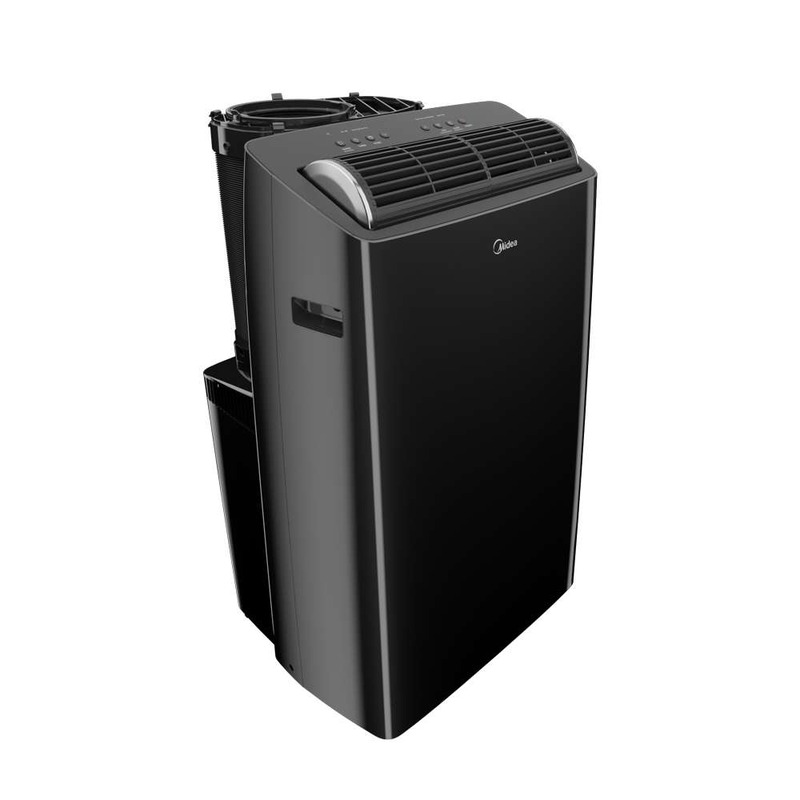 1. Midea Duo MAP14HS1TBL: Best Overall Portable Air Conditioner
Dual-hose inverter cooling with heating capability and dead-quiet operation at full power
|
BTU |
14,000 ASHRAE / 12,000 SACC |
|
Coverage |
Up to 550 sq. ft. |
|
Dimensions |
17.8" W × 15.5" D × 31.2" H |
|
Measured noise output |
42 dB (low) · 55 dB (high) |
|
Weight |
74 lbs |
|
Extras |
Heating, dehumidification, fan, Wi-Fi app, Alexa/Google, remote control |
|
Warranty |
1 year parts and labor |
Best for:
- Cooling mid-size to large rooms where a single-hose unit can't keep up
- Year-round use — the heating mode handles shoulder seasons without a space heater
- Light sleepers who need the AC running overnight without disruption
- Anyone who wants app control and voice commands baked in from the start
Skip if:
- You need to move the unit between rooms or floors frequently — 74 pounds is no joke on stairs
- Your budget is tight — this is a $500+ investment before electricity costs
The Cooling Power Gap Between Single-Hose and Dual-Hose Is Real
Most portables on this list advertise 14,000 BTU on the box, but their SACC — the rating that reflects real-world cooling — drops to 7,000–8,000 once you account for heat leaking back through the exhaust hose. The Midea Duo holds at 12,000 SACC. That gap shows up the moment you turn it on.
The Duo's hose-in-hose design is why. One channel pushes hot exhaust air outside while the other draws outdoor air to cool the condenser — so the unit isn't stealing already-cooled air from your room. In our 150-square-foot test bedroom, the temperature fell from 90°F to 80°F in roughly 10 minutes. After an hour, it sat at 72°F. Single-hose portables at the same BTU rating took 30 minutes for that same 10-degree drop and never got below 75°F.
In the larger 400-square-foot living space, the Duo still pulled its weight. It didn't cool the room as aggressively — you'll feel the difference compared to a window unit — but it brought the temperature down steadily and maintained it without constant compressor cycling.
Quiet Enough to Sleep Through
We measured 42 dB on low and 55.4 dB on high from four feet away. For context, 42 dB is quieter than most refrigerators. On high, you'll hear a smooth, consistent hum — but there's no harsh compressor buzz or rattling that makes you grit your teeth after a few hours.
The inverter compressor is the reason. Traditional portables slam the compressor on at full blast and then shut it off entirely — that jarring on-off cycling wakes you up at 3 a.m. The Midea Duo ramps compressor speed up and down gradually. Once the room hits your target temperature, the unit throttles back to a whisper. We slept through it on medium without issue.
One small annoyance: we noticed a faint plastic rattle from behind the rear filter panel at certain compressor speeds. A small piece of foam tape fixed it in seconds, but it shouldn't be there on a unit at this price.
The App Works, the Controls Make Sense
The Midea SmartHome app connected to our Wi-Fi on the first try. Full control over temperature, fan speed, mode, and scheduling. Alexa and Google voice commands worked without fuss.
The onboard panel and physical remote cover the basics, but the app is where you'll live. The remote lacks a backlight — worth knowing if you reach for it at night.
Installation Takes Patience, Not Skill
Plan for about 25 minutes the first time. The hose-in-hose system stores inside the unit (a nice detail come storage season), but pulling it out and fitting the five-piece window kit requires some fiddling. Midea includes foam insulation strips for the window sliders — the only brand we tested that does this — and the seal quality is noticeably better for it.
Once installed, you won't touch the window kit again until storage. The hose is stiff, though — keep the Duo within a few feet of the window, and don't plan on rotating it after setup without disconnecting things.
Energy Efficiency Stands Out Among Portables
Inverter technology means the compressor doesn't run at 100% all the time. During our energy monitoring, the Duo consumed noticeably less power once the room reached temperature — ramping down rather than cycling off entirely. Over a projected 90-day summer at 12 hours per day, the Duo's operating cost came in lower than every non-inverter unit we tested at the same BTU level. Midea claims 40% savings over the federal standard, and our measurements tracked close to that.
You're still running a portable AC, so expect a bump in your electric bill. But compared to traditional-compressor models like the Black+Decker, the savings add up over a full cooling season.
What You're Giving Up
At 74 pounds, the Midea Duo is a two-person lift on stairs. Casters roll fine on hard floors but struggle on carpet. If you plan to shuffle it between rooms daily, look elsewhere.
Build quality is average for the category — sturdy enough, nothing rattled loose during testing. But long-term user reports flag hose fittings degrading after a year or two, and the concentric hose design makes replacements harder to source. Store it dry — some users report mold forming inside the hose-in-hose system over the off-season.
Dehumidification is strong at nearly 125 pints per day, but dry mode requires the included drain hose — there's no internal bucket. In cooling mode, the self-evaporating system handled condensation on its own throughout our testing.
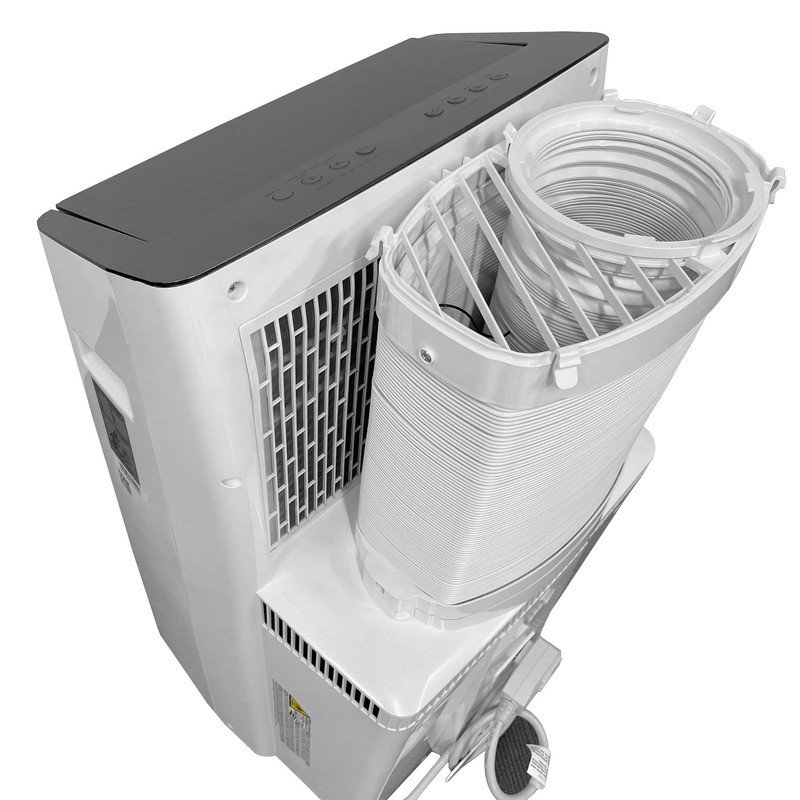 2. Whynter NEX ARC-1230WN: Best Portable Air Conditioner for Large Rooms
The strongest cooling output we tested, paired with inverter-quiet operation and solid app control
|
BTU |
14,000 ASHRAE / 12,000 SACC |
|
Coverage |
Up to 600 sq. ft. |
|
Dimensions |
19.5" W × 16.75" D × 32.5" H |
|
Measured noise output |
42.5 dB (low) · 49.5 dB (medium) · 56.5 dB (high) |
|
Weight |
77 lbs |
|
Extras |
Dehumidification (87 pints/day), fan, Wi-Fi (NetHome Plus app), Alexa/Google, remote control, auto-swing louver, auto-drain |
|
Warranty |
1 year (3 years compressor) |
Best for:
- Open-plan living areas, lofts, and large bedrooms over 400 square feet
- Hot climates where single-hose portables can't keep up
- Garages and workshops that run hot
- Anyone who wants set-it-and-forget-it operation with the auto-drain and smart scheduling
Skip if:
- You're on a budget — this is the most expensive portable AC on our list at $600–$700
- You need to move it between floors regularly, because 77 pounds with back-heavy weight balance makes stair carries miserable
Out-Cooled Everything Else by a Wide Margin
No other portable we tested came close to the Whynter's cooling output. Our test room dropped 11.9°F in one hour — the average across all units was closer to 6–7 degrees over the same period. When outside temperature climbed above 95°F, this was one of the only portables that didn't start falling behind.
That gap comes down to the dual hose-in-hose design preventing the negative pressure problem that cripples single-hose units in hot weather, and the inverter compressor adjusting speed on the fly instead of cycling between full blast and off. Steadier cooling, lower energy bills.
The 80-degree auto-swing louver helps too. Instead of blasting cold air in one fixed direction, the Whynter distributes airflow across a wide arc. We noticed more even temperature across the room compared to units with static or manually adjustable vents.
Quieter Than You'd Expect From This Much Power
A unit with the highest cooling output in our lineup should be loud. The Whynter wasn't. We recorded 58.4 dB from four feet away on high — below average for the group — and the sound character was clean. No harsh compressor rattle, no whine. A steady hum that faded into the background.
On low, it dropped to 42.5 dB. Close to library-quiet. Because the inverter compressor ramps up gradually rather than slamming on at full speed, you avoid those jarring noise spikes that wake you up at 3 a.m.
You can sleep with this running on low or auto. On high, it's noticeable but not intrusive — we held conversations at normal volume without raising our voices.
Setup Is the Easiest We Tested
The exhaust hose comes pre-installed in the unit — saving you 10–15 minutes of fiddling compared to every other portable we tested. Pull it out, snap the window kit together (about five minutes our first time), and you're done.
The window kit accommodates openings up to 82 inches wide (on the WNH2 model) or 49 inches on the standard version, and the foam insulation included does a decent job of sealing gaps. We didn't need duct tape or aftermarket weatherstripping to get a tight fit, which is more than we can say for several competitors.
The App Does More Than the Remote
The NetHome Plus app handles all the basics — temperature, fan speed, mode switching, scheduling — but it's the location-based automation that set it apart during daily use. You can configure the Whynter to start cooling when you're heading home and power down when you leave, which eliminated the problem of forgetting to turn it off. The 24-hour timer, sleep curve, and express-run presets add flexibility that the physical remote can't match.
Alexa and Google voice commands worked reliably. The display is a touch dim in bright rooms, but all critical info is readable.
Self-Evaporating Drain Means Less Babysitting
Whynter's auto-drain system recycles condensate through the cooling process. We ran this unit for weeks in moderate humidity and never dealt with a full tank warning.
For high-humidity environments, a gravity drain hose is included for continuous drainage. The display also alerts you when the filter needs cleaning.
Weight and Footprint Are the Real Tradeoffs
At 77 pounds, this is the heaviest portable we tested. The weight sits toward the back right side, so carrying it feels off-balance. Rolling it across hard floors? Fine. Short-pile carpet? Manageable. Anything thicker, and you're pushing hard with a real risk of tipping the unit.
The footprint is also larger than most — 19.5 inches wide and nearly 33 inches tall. In a spacious living room, that's barely noticeable. In a tight bedroom, it eats into floor space you'll feel.
Our advice: pick a room, set it up for the season, and leave it there. This isn't a unit you want to wheel between rooms every few days.
Three-Year Compressor Warranty
Most portable ACs cover you for one year. Whynter extends the compressor to three — and since the compressor is the most expensive part to replace, that's a meaningful difference at this price point.
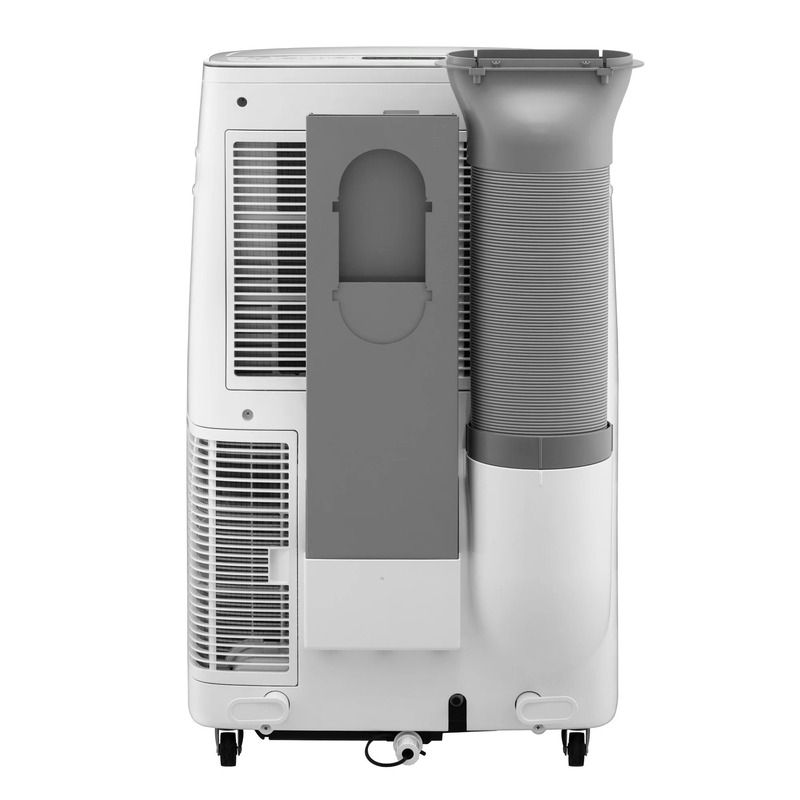 3. LG LP1419IVSM — Quietest Portable Air Conditioner
Dual inverter that runs so quietly you'll check twice to see if it's on
|
BTU |
14,000 ASHRAE / 10,000 SACC |
|
Coverage |
Up to 450 sq. ft. |
|
Dimensions |
17.7" W × 14.8" D × 30.1" H |
|
Measured noise output |
42–45 dB (sleep mode) / ~52 dB (high) |
|
Weight |
70.5 lbs |
|
Extras |
Dehumidification, fan, remote control, Wi-Fi (LG ThinQ app), Alexa & Google Assistant, auto-swing louver, auto-evaporation, sleep mode |
|
Warranty |
1 year parts and labor |
Best for:
- Bedrooms where background noise keeps you up
- Home offices where you take calls or record audio
- Rooms up to 400 sq. ft. that need steady, all-day cooling
Skip if:
- You need to cool spaces bigger than 450 sq. ft. — single-hose design loses ground in large open areas
- Carrying 70+ pounds up a staircase is a dealbreaker
You Might Forget It's Running
On sleep mode, our decibel meter read between 42 and 45 dB from four feet away. We literally had to walk up and put a hand near the vent to confirm the compressor was still going.
The dual inverter ramps compressor speed up and down gradually instead of the hard on/off cycling you get from conventional portables. No jarring startups at 3 a.m. Just a low, even tone you stop noticing after a few minutes. On high, we measured around 52 dB — still quieter than most competitors on their low setting. And the unit rarely stays on high for long. Once your room hits the target temperature, it dials back to near-silent cruise on its own.
Solid Mid-Range Cooling, With a Caveat
In our 150-square-foot test room starting at 90°F, the LG hit 80°F in about 10 minutes and 75°F within 30 minutes. Strong for a single-hose unit.
The catch: single-hose portables exhaust air out the window, which pulls warm outside air back in through any gap — doorways, window seals, hose kit edges. In a small bedroom with the door closed, barely noticeable. In a 400-square-foot open space, the LG worked noticeably harder to hold temperature. For larger open plans, the dual-hose picks on this list are a better fit.
The ThinQ App Is One of the Few Worth Using
Pairing took under two minutes. From there — temperature, fan speed, mode switching, scheduling, energy monitoring, all on your phone. The scheduling alone earned its keep: setting the AC to kick in 20 minutes before you get home, without a smart home hub, is something you'll use daily. Alexa and Google voice commands worked reliably.
The onboard control panel is less impressive. Dim display in bright rooms, no quick-access button for switching between cooling and fan-only — you cycle through modes instead. The remote handles it better.
Setup and Maintenance
Window kit, hose, plug in — cold air in 8 minutes. Auto-evaporation handled condensate through weeks of testing; we never drained it manually. Washable filter pops out, rinses under the tap, 90 seconds every two weeks.
At 70.5 pounds, casters roll smoothly on hard floors. Stairs need a second pair of hands.
Worth Noting
The compressor generates mild radio frequency interference. Didn't affect Wi-Fi, Bluetooth, or streaming — but sensitive audio gear in the same room may pick up buzzing. The LG uses R32 refrigerant, which carries a lower global warming potential than the R410a found in many competitors.
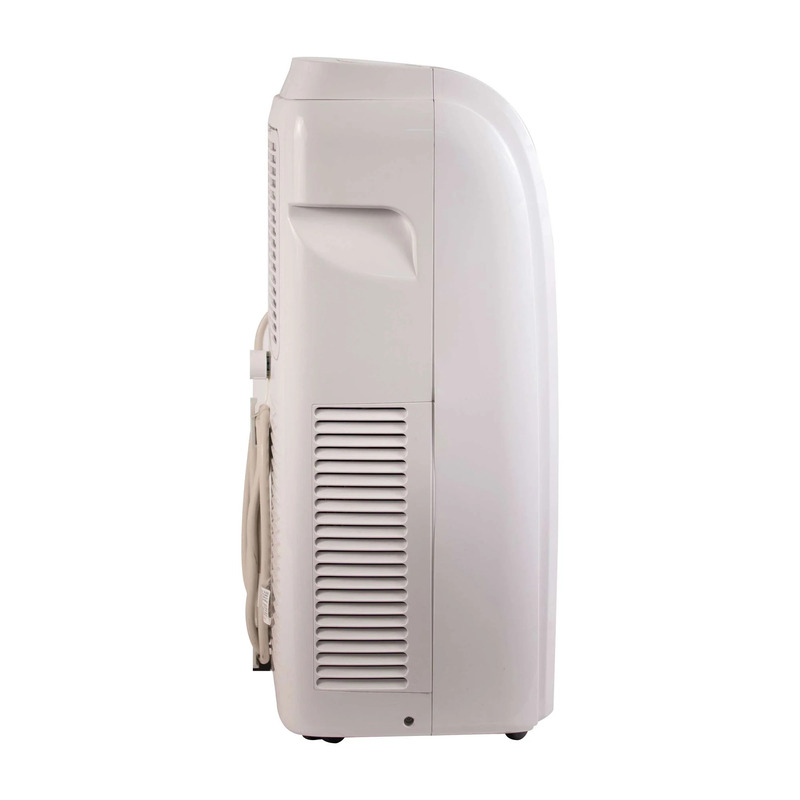 4. Black+Decker BPACT14WT — Best Value Portable Air Conditioner
Smart features and real cooling for under $400 — if you size your expectations right
|
BTU |
14,000 ASHRAE / 7,700 SACC |
|
Coverage |
Up to 350 sq. ft. |
|
Dimensions |
16.5" W × 14.06" D × 27.09" H |
|
Measured noise output |
54–59 dB |
|
Weight |
59.8 lbs |
|
Extras |
Dehumidification, fan, remote control with follow-me sensor, Wi-Fi app, Alexa & Google Assistant, 24-hr timer, sleep mode |
|
Warranty |
1 year |
Best for:
- Buyers who want Wi-Fi and voice control without paying $500+
- Bedrooms and mid-size rooms up to 300 sq. ft.
- Renters who need quick, tool-free installation
- First-time portable AC buyers
Skip if:
- You're cooling a large or poorly insulated room — the 7,700 SACC means real-world output is well below that 14,000 headline number
- Energy costs concern you — this was one of the hungrier units we tested
- You're in California — this model isn't sold there
The Gap Between the Sticker and Reality
The 14,000 BTU ASHRAE rating and the 7,700 BTU SACC rating describe two very different air conditioners. ASHRAE measures cooling under ideal lab conditions. SACC factors in heat leaking back through the exhaust hose and warm air seeping in from outside. At 7,700 SACC, this unit has roughly half the effective cooling capacity of the Midea Duo or Whynter ARC-1230WN.
In our 150-square-foot test room at 90°F, the Black+Decker reached 80°F in about 30 minutes — slower than the dual-hose units, but it held comfortable temperatures through the afternoon once it got there. Push it past 350 square feet or throw a sunny west-facing window into the mix, and it struggles.
Fastest Setup We Tested
Box to cold air in under 7 minutes. The window kit clicks together without tools — twist, snap, done. The exhaust hose locks in with a quarter turn. Packing it away is just as fast; everything disconnects by hand.
The hose end has a grate to keep birds and rodents out of the exhaust — none of the other units include this.
The Follow-Me Remote
Wi-Fi, app control, and voice assistant support in a sub-$400 portable AC is unusual. The app covers the basics — temperature, fan speed, mode, scheduling — and it works, which already puts it ahead of several pricier competitors.
The follow-me remote is the real differentiator, though. It has a built-in temperature sensor, so the AC adjusts based on conditions where you are sitting, not where the unit is standing. If the air near the AC reads 70°F while you're still warm 15 feet away on the couch, the remote catches that gap. We noticed a real difference in comfort compared to using the standard controls.
The Energy Bill Catch
This unit draws 1.27 kWh on high with the compressor running. Over a 90-day summer at 12 hours daily, that projects to roughly $220 in electricity — among the highest we recorded. No inverter technology here, so the compressor runs at full power whenever it's on.
For a bedroom running 4–6 hours a day, manageable. For all-day cooling through a long summer, an inverter model like the LG or Midea Duo could pay for its price premium within one season through energy savings alone.
Noise and Build Quality
At 54–59 dB, middle-of-the-pack. The compressor hum is the dominant sound — fine during the day, potentially annoying for light sleepers.
The price shows in the build. Thinner plastic than the Whynter or Midea units, shallow handles that aren't great for carrying, higher rolling resistance on carpet. It works. It doesn't feel like it'll last five years. Over 32,000 Amazon reviewers rate it 4+ stars, though roughly 15% report issues within the first few months — a higher failure rate than the pricier models on this list.
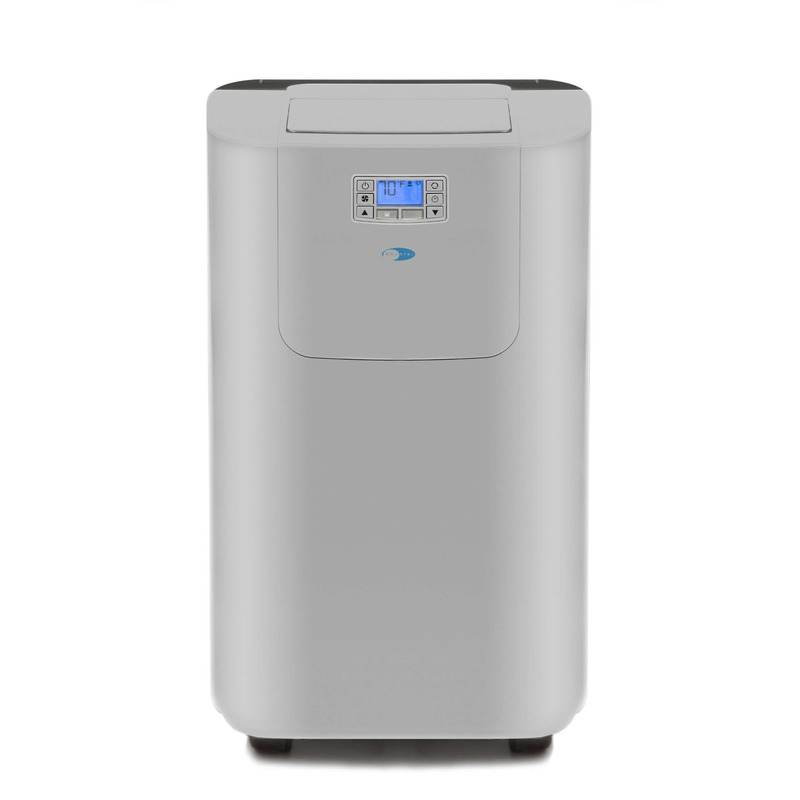 5. Whynter Elite ARC-122DS — Best Portable Air Conditioner for Small Rooms
Compact dual-hose cooling with activated carbon filtration and barely-there noise
|
BTU |
12,000 ASHRAE / 7,000 SACC |
|
Coverage |
Up to 400 sq. ft. |
|
Dimensions |
14.75" W × 13.75" D × 28" H |
|
Measured noise output |
47 dB (low) / 52–56 dB (high) |
|
Weight |
56 lbs |
|
Extras |
Dehumidification, fan, remote control, activated carbon filter, dual-hose, auto-drain, 24-hr timer |
|
Warranty |
1 year (3 years compressor) |
Best for:
- Bedrooms, home offices, and apartments under 350 sq. ft.
- Hot climates where single-hose units can't keep up
- Buyers who want dual-hose benefits without a 75-pound beast
- Server rooms, workshops, or garages that need targeted cooling
Skip if:
- You want Wi-Fi or app control. This one has a remote and onboard buttons, period
- Your room is bigger than 400 sq. ft.
Dual-Hose in a Smaller Body
Most dual-hose portables are large, heavy, and built for big rooms. The ARC-122DS is not. At 56 pounds and 28 inches tall, it's noticeably more compact than the Whynter 1230WN or Midea Duo. We moved it between a bedroom and a home office several times during testing. It's light enough to carry up a flight of stairs alone, though a second pair of hands still makes it easier.
Why does the dual-hose part matter in a small room? Because small rooms expose the weakness of single-hose units faster. A single-hose AC exhausts air out the window and creates negative pressure, pulling warm air in through door gaps and cracks. In a tight bedroom, that incoming warm air has nowhere to hide. The ARC-122DS avoids this entirely. One hose pulls fresh air in, the other pushes hot air out. Pressure stays balanced. The room cools more evenly and the compressor doesn't have to fight its own side effects.
Quiet Enough for Sleep
We measured 55.9 dB on high from four feet away. Our testers didn't flag any harsh tones, rattles, or compressor whine at any speed. It's not the quietest unit on this list (the LG wins that), but the sound is clean and consistent. More white noise than mechanical grind. We slept with it running on low without issues.
Cooling: Honest for the Size
This is a 7,000 SACC BTU unit. It dropped our test room by 10°F over 60 minutes with outside temperatures in the mid-to-high 80s. A 6.75°F drop came within the first 20 minutes. That's solid for a room under 300 square feet. It won't freeze you out. It will take the edge off a hot day and keep the space comfortable once it reaches your set temperature.
Where we noticed the limit: on days pushing past 95°F, the ARC-122DS held temperature but couldn't lower it further. The dual-hose design gives it more effective cooling per BTU than single-hose units, but raw cooling power still has a ceiling here. If you regularly deal with triple-digit heat, step up to the 1230WN.
The Activated Carbon Filter
Most portable ACs have a basic mesh filter that catches dust. The ARC-122DS adds an activated carbon layer that absorbs odors and some VOCs. We can't quantify air quality improvement without lab equipment, but we did notice less of that stale, recycled-air smell you sometimes get after running a portable AC all day in a closed room. The pre-filter is washable. Replacement carbon filters cost around $15 and last a few months.
No Smart Features
No Wi-Fi. No app. No voice assistant. Just a digital control panel and a remote that handles temperature, fan speed, timer, and mode selection.
That worked fine for us. The remote works. The onboard controls are clear. The 24-hour timer lets you schedule on/off cycles. We didn't miss the app once during testing — the ARC-122DS just ran quietly in the background without needing attention.
Auto-Drain and the Window Kit
Whynter's auto-drain system recycles condensate through the cooling process. Over weeks of testing, we never emptied a tank or attached a drain hose. In high-humidity climates, you may eventually need to use the gravity drain ports on the back, but for most conditions, it's hands-off.
The window kit is functional but finicky. The plastic panels fit standard double-hung and sliding windows, though we had to trim foam insulation strips to get a tight seal. If your windows are non-standard sizes, expect some DIY. Whynter includes a storage bag with a pocket, which is a nice touch when you put the unit away for winter.
The 3-year compressor warranty stands out — most competitors cover one year on everything and call it done.
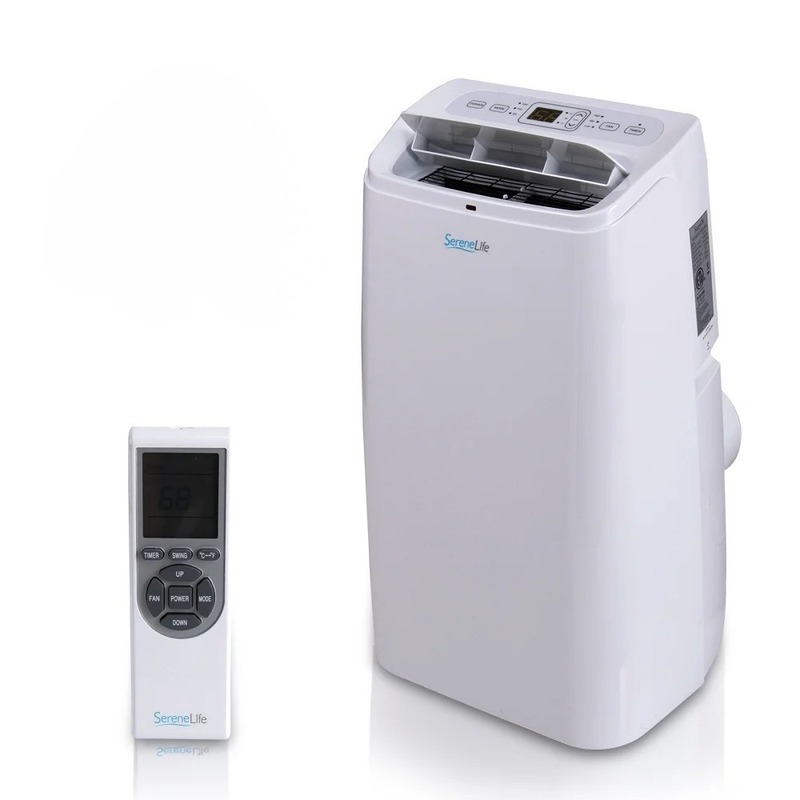 6. SereneLife SLPAC10 — Most Portable and Easiest to Set Up
52 pounds, five-minute install, and enough cooling for a bedroom on a budget
|
BTU |
10,000 ASHRAE |
|
Coverage |
Up to 300 sq. ft. |
|
Dimensions |
13.8" W × 14.6" D × 27.2" H |
|
Measured noise output |
55–61 dB |
|
Weight |
52.3 lbs |
|
Extras |
Dehumidification, fan, remote control, auto-swing louvers, sleep mode, 24-hr timer |
|
Warranty |
1 year |
Best for:
- Renters who move the AC between rooms or apartments regularly
- Bedrooms and small living spaces under 250 sq. ft.
- Budget buyers who prioritize ease of use over raw performance
- Anyone who dreads setup day
Skip if:
- You need to cool anything larger than 300 sq. ft.
- Compressor noise bothers you — this one is audible
- You want Wi-Fi, app control, or any smart features
The Lightest Unit We Tested
At 52.3 pounds, the SereneLife was the easiest AC to carry upstairs. The handles sit at a good depth and position — a small detail that most manufacturers get wrong. Weight distribution leans toward the right side, but not enough to make it awkward. On hard floors, the casters roll straight and smooth. On carpet, rolling resistance goes up (as it does with every portable AC), but the lighter weight keeps it manageable.
We moved this unit between three rooms during testing and never felt like it was a chore. If you're the kind of person who cools the bedroom at night and the home office during the day, the SereneLife makes that routine painless.
Five-Minute Window Kit
The sliding window panel locks into place with tabs — no screws, no tools, no trimming foam strips to size. We timed the full install from sealed box to cold air at just under five minutes. Breakdown was even faster. Twist the hose off, pop the window panel out, done.
One catch: the window kit works best with standard-width windows. If yours are unusually wide or narrow, the panel may not cover the gap properly. We tested it in a 28-inch-wide double-hung window and a 36-inch slider with no issues.
Cooling: Adequate, Not Impressive
This is a single-hose, 10,000 BTU unit with no inverter. It cools, but it won't wow you. In our test room, we recorded a 6.3°F temperature drop over one hour. That's below the dual-hose units on this list by a clear margin.
For a bedroom under 250 square feet with the door closed, the SereneLife held a comfortable temperature through the afternoon. Once the room reached the target, it maintained it fine. We wouldn't rely on it for anything bigger, and on days above 95°F, it ran continuously without getting the room as cool as we'd like.
Energy Efficient for Its Class
At 0.96 kWh per hour on high, this was one of the more energy-efficient portable air conditioners we tested. Over a 90-day summer at 12 hours daily, projected electricity cost came to around $132 — significantly less than the Black+Decker or Whynter 1230WN. If you're running a portable AC all summer in a small room, that difference adds up.
The Noise Trade-Off
We measured 61 dB on high from four feet away. That's the loudest unit on this list. The fan itself is average, but the compressor adds an irritating hum that our testers noted repeatedly. On low, it drops to around 55 dB — livable during the day, but light sleepers will notice it.
No sleep mode magic here. Turning the fan to low is your only option for quieter nighttime operation.
No Frills, and That's the Point
No Wi-Fi. No app. The remote covers power, mode, temperature, fan speed, timer, and swing. The onboard touch panel with LED display does the same. Both are responsive and self-explanatory.
The washable filter slides out from the back. Auto-swing louvers distribute air reasonably well for a single-vent unit. The built-in dehumidifier pulls moisture but requires a drain hose or manual emptying in humid climates — no auto-evaporation here.
At its typical $250–$340 street price, the SereneLife is the cheapest unit on this list. You feel that in the build — lighter plastics, simpler engineering, no premium touches. But for a bedroom AC you can set up in five minutes and carry with one hand, it does exactly what it needs to do.
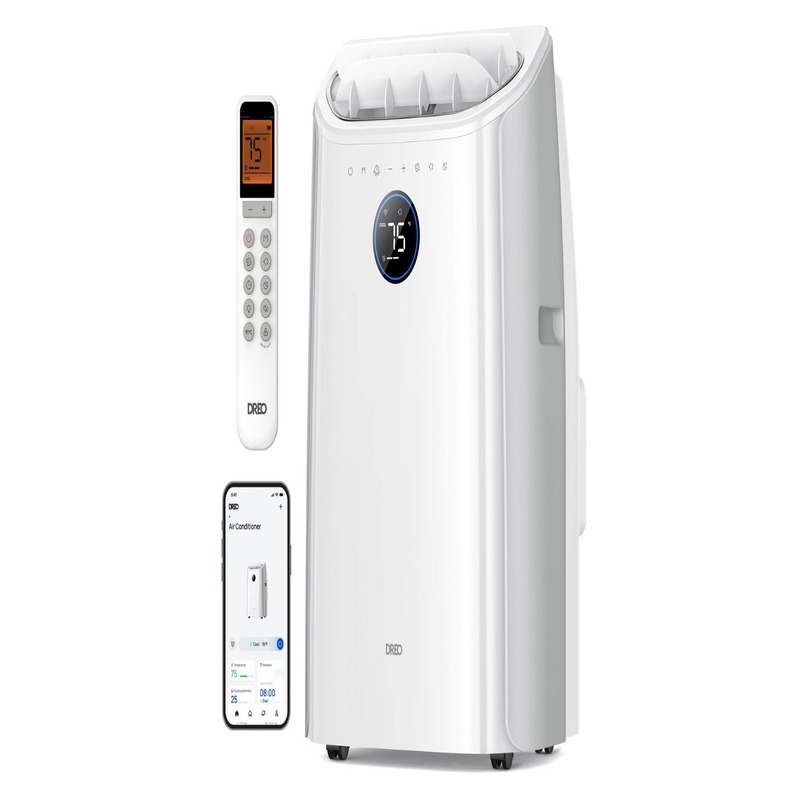 7. Dreo AC516S — Best Smart Features and Design
The portable AC that looks like someone actually thought about how it fits in your room
|
BTU |
14,000 ASHRAE |
|
Coverage |
Up to 300–400 sq. ft. |
|
Dimensions |
17.3" W × 14.4" D × 28.1" H |
|
Measured noise output |
~46 dB (low) / ~56 dB (high) |
|
Weight |
63 lbs |
|
Extras |
Dehumidification, fan, remote control, Wi-Fi app (Dreo), Alexa & Google Assistant & Siri, drainage-free design, ECO mode, magnetic remote holder |
|
Warranty |
1 year |
Best for:
- Buyers who want the best app experience among portable ACs
- Bedrooms and offices up to 300 sq. ft. where aesthetics count
- Anyone burned by clunky smart-home pairing on other units
- Humid climates — the drainage-free design handles up to 85% humidity without manual emptying
Skip if:
- You need to cool more than 350 sq. ft. reliably — effective range is closer to 300
- You want dual-hose efficiency
- You need heating — cooling, dehumidifying, and fan only
The App Other Brands Should Copy
The Dreo app paired on the first try and loaded in under a minute. Temperature control, fan speed, mode switching, humidity monitoring, custom cooling curves, and scheduling — all on one clean screen without buried menus or lag.
Custom cooling curves are the feature we kept coming back to. You set a temperature schedule that ramps down gradually over the evening — 72°F at 10 p.m., 70°F at midnight, 68°F by 2 a.m. — instead of locking one temperature all night. We slept noticeably better with this than a flat setpoint. Most competing apps don't offer anything close.
Alexa, Google Assistant, and Siri all worked without extra hubs or workarounds.
It Doesn't Look Like an Appliance
Most portable ACs look like plastic boxes with vents. The Dreo has smooth curves, a glossy circular LCD display, and subtle branding. The magnetic strip on top holds the remote in place — no hunting between couch cushions. The filter pops out from the back without tools, and the exhaust hose slides in with a clean snap connection.
If the AC is going to sit in your bedroom for four months, how it looks and feels to interact with daily isn't trivial.
Cooling Performance
In a 240-square-foot room starting at 80°F, the Dreo dropped temperature to 70°F in 45 minutes. Respectable for a single-hose unit. The swing louvers move in a wave pattern rather than a fixed arc, which spread cool air more evenly than the static vents on units like the Black+Decker.
The 14,000 ASHRAE rating is optimistic for real-world use — Dreo's own documentation lists 300 sq. ft. as optimal. We'd agree. In our 400-square-foot test, it cooled the area near the unit but left far corners warm.
Drainage-Free in Most Climates
The self-evaporating system uses a built-in water pump and condenser to recycle moisture automatically. Below 85% humidity, you won't drain this unit. We tested it through several weeks and never touched the drain plug. In very humid climates — Gulf Coast summers, for example — occasional manual draining may still be necessary. The plug is on the back, easy to access.
Where It Falls Short
ECO mode cycles the compressor on and off to save energy, but the temperature swings during those cycles are wider than what you get from a true inverter. The room warms a few degrees before the compressor kicks back in. If steady temperature is more important to you than energy savings, leave ECO off.
At $400–$450, you're paying a premium for the smart features and design over raw cooling power. The Whynter Elite costs about the same, gives you dual-hose efficiency, and cools more aggressively — but has no app, no Wi-Fi, and looks like every other portable AC on the market. Which trade-off bothers you less is the deciding factor between them.

.jpg?height=200&name=13130%20(1).jpg)