





























.jpg)
Cigarette smoke doesn't just linger - it bonds. The 7,000+ chemicals in tobacco smoke create what researchers call "thirdhand smoke": a residue that embeds into fabrics, drywall, and even dust particles, then slowly re-releases for months. That's why the guest room still reeks three weeks after your uncle's visit.
The good news? You can fight back at every timescale. Some methods clear the air in minutes. Others take hours. A few require overnight commitment but deliver results nothing else matches. This guide organizes solutions by how fast they work, so you can pick the right approach for your situation - whether that's guests arriving in 20 minutes or finally tackling a smoke-damaged rental.
Instant Fixes: Under 30 Minutes
When you need to remove cigarette smell from a room fast, these methods deliver noticeable results before your next meeting, visitor, or video call.
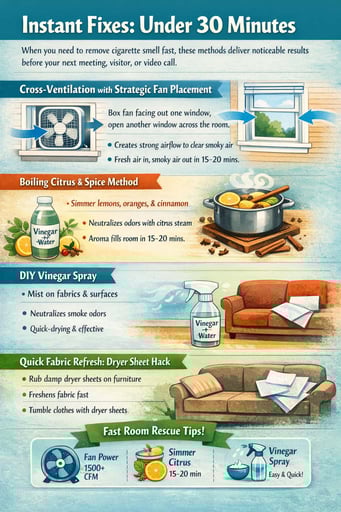 Cross-Ventilation With Strategic Fan Placement
Opening windows helps. Opening windows correctly changes everything.
Place a box fan facing outward in one window - this creates negative pressure that actively pulls smoky air outside rather than just diluting it. On the opposite side of the room (or house), open another window to let fresh air rush in. The pressure differential forces contaminated air out instead of letting it drift aimlessly.
For single-window rooms, point the fan outward in the lower half of the window opening. Warm, smoke-laden air rises, so you want the exhaust low while fresh air enters through the gap above. Run this setup for 15-20 minutes and you'll notice a dramatic difference.
Why it works so fast: You're physically replacing the air volume rather than trying to filter or neutralize it. A standard box fan moves 1,500-2,500 CFM (cubic feet per minute) - enough to cycle a 12x12 room's entire air volume in under three minutes.
The Boiling Citrus and Spice Method
Fill a pot with water, add sliced lemons or oranges, throw in cinnamon sticks or whole cloves, and bring to a simmer. The steam carries aromatic compounds throughout the room while the moisture helps lift smoke particles off surfaces temporarily.
This isn't masking - the acidic citrus vapor actually binds with some alkaline smoke compounds. Keep it simmering for 15-20 minutes with good ventilation, and the space will smell noticeably different.
Variations that work:
- Lemon + rosemary
- Orange peel + vanilla extract (add vanilla after removing from heat)
- Apple cider vinegar (2 cups in the pot) - smells harsh during, but neutralizes effectively
DIY Vinegar Spray for Fabrics and Surfaces
Mix equal parts white vinegar and water in a spray bottle. Lightly mist curtains, upholstery, and fabric surfaces - not soaking wet, just damp. The acetic acid neutralizes alkaline smoke residue on contact.
The vinegar smell dissipates within 10-15 minutes as it dries, taking much of the cigarette odor with it. For leather furniture or delicate fabrics, test an inconspicuous spot first.
Speed tip: Add 10-15 drops of essential oil (eucalyptus or lemon work well) to the spray. The oil helps mask any lingering vinegar scent and adds its own odor-fighting properties.
Quick Fabric Refresh: The Dryer Sheet Hack
For a cigarette smell embedded in a couch or chair you can't wash, try this: Dampen a few dryer sheets and rub them across the fabric surface. The surfactants in dryer sheets bind to odor molecules while leaving behind a fresh scent.
For clothing that absorbed smoke at a party, toss items in the dryer with two or three dryer sheets on a no-heat tumble cycle for 10 minutes. The tumbling action releases trapped particles while the sheets neutralize what remains.
Quick Fixes: 1 to 4 Hours
These methods need more time to work but require minimal effort once set up. Start them, handle other tasks, and return to a noticeably fresher room.
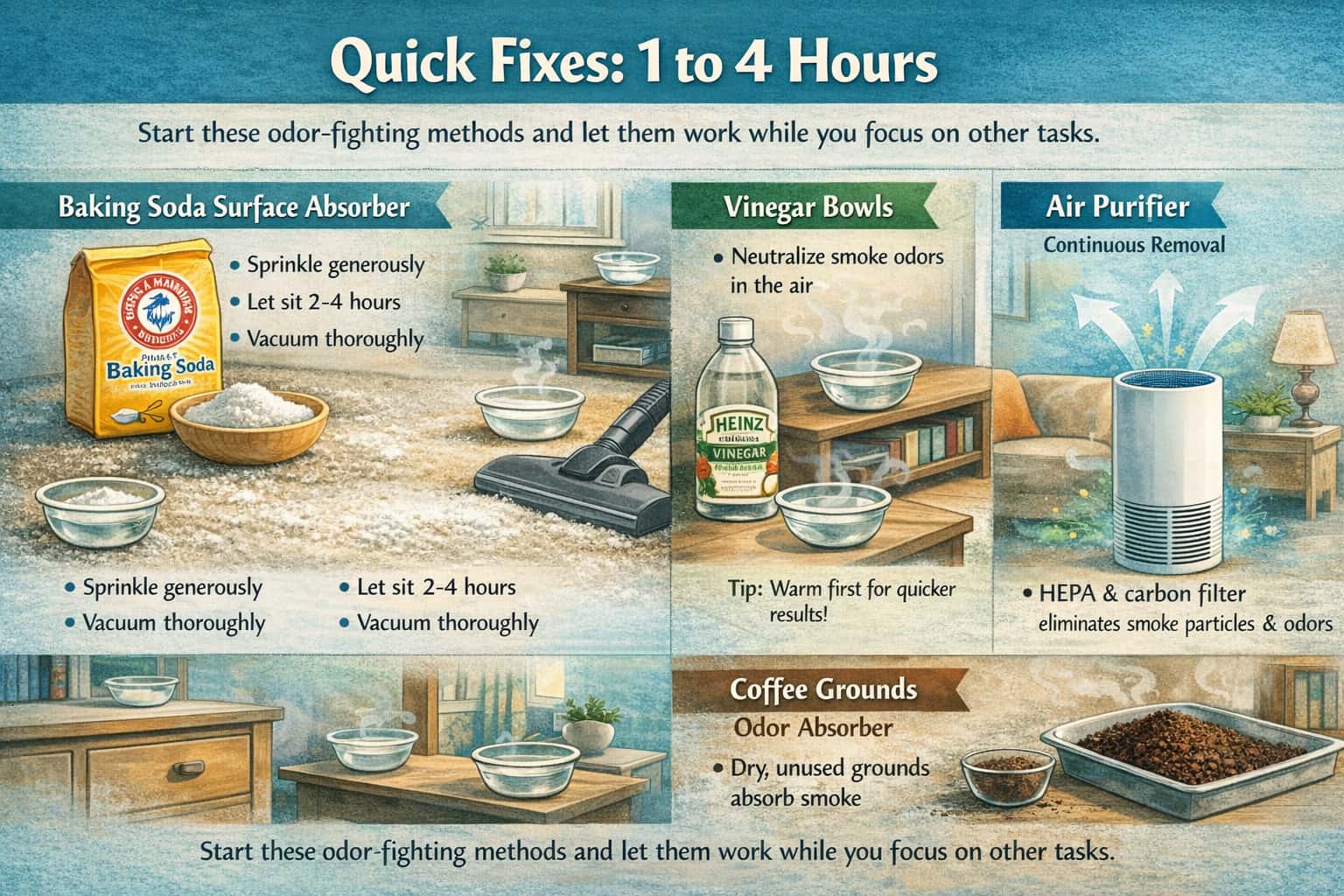 Baking Soda: The Surface Absorber
Baking soda doesn't mask odors - it neutralizes them through chemical reaction. Smoke residue tends toward acidic, and baking soda's alkaline nature binds with those compounds permanently.
For carpets and rugs, sprinkle a generous layer across the entire surface. Don't be shy - you want visible coverage, not a light dusting. Let it sit for 2-4 hours minimum (overnight is better, but we'll cover that in the next section). Vacuum thoroughly with a machine that has good suction.
For upholstered furniture, the same approach works. Sprinkle, wait, vacuum. Focus extra attention on armrests and headrest areas where smoke residue concentrates from contact.
The bowl method for air: Place shallow bowls of baking soda around the room - on counters, shelves, side tables. The exposed surface area absorbs airborne odor molecules gradually. Less dramatic than surface treatment, but it helps. Swap out the baking soda every 24-48 hours if the smoke smell is heavy.
Vinegar Bowls: Passive Acid Neutralization
Set out small bowls of undiluted white vinegar in corners and near the worst-smelling areas. The acetic acid vapor neutralizes alkaline smoke compounds floating in the air.
Yes, the room will smell like vinegar for a few hours. That smell disappears completely once you remove the bowls and ventilate briefly - and it takes the cigarette smell with it. For faster results, warm the vinegar slightly before setting it out (don't boil - just warm). The increased evaporation rate speeds up the neutralization process.
Placement strategy: Put bowls near fabric surfaces that absorbed smoke - couches, curtains, bedding. These items off-gas continuously, so positioning the vinegar nearby catches those emissions at the source.
Air Purifiers: Active Continuous Removal
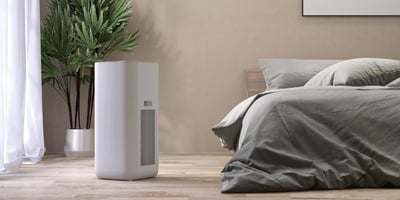
While DIY methods work in bursts, an air purifier attacks smoke particles and odor compounds continuously. Within 1-2 hours of runtime, a properly sized unit can cycle your room's air volume multiple times, capturing particles with each pass.
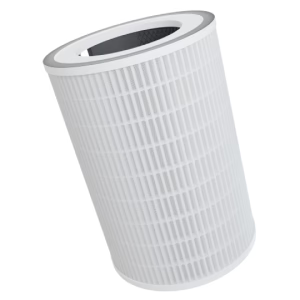
The key is filter type. HEPA filters catch 99.97% of particles down to 0.3 microns - that covers most smoke particulates. But particles alone don't create the smell. You need activated carbon filtration to absorb the volatile organic compounds (VOCs) that your nose actually detects. Units with thin carbon pre-filters won't cut it for cigarette smoke; you need substantial carbon beds.
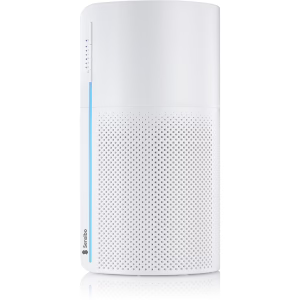
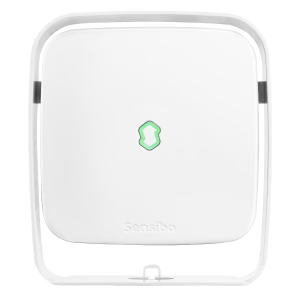
Air purifiers can effectively eliminate smoke smells when they combine both filter types - HEPA for particles, activated carbon for gases and odors. The Sensibo Pure uses this dual-filtration approach with HEPA capturing particles down to 0.1 microns, plus enough activated carbon to handle VOCs from smoke, cooking, and household chemicals. The smart scheduling feature lets you run it harder when contamination is active (during or right after smoking) and dial back during clean periods.
Sizing matters: Don't trust manufacturer room ratings at face value - they're often optimistic. For smoke specifically, size up. A purifier rated for 300 sq ft will struggle in a 300 sq ft room with active smoke contamination. Treat the rating as a maximum and use it in smaller spaces for faster air cycling.
Coffee Grounds: The Underrated Absorber
Dry, unused coffee grounds absorb odors through the same porous surface mechanism as activated charcoal - just less efficiently. But they're cheap, you probably have them already, and they work.
Spread grounds on baking sheets or in shallow bowls. Place them around the room and leave for 3-4 hours. The grounds absorb smoke odors while releasing a mild coffee scent that most people find pleasant.
Important: Use dry grounds, not wet spent grounds from your morning brew. Wet grounds grow mold within days. Dry grounds from an unopened bag or the discount bin work perfectly.
For enclosed spaces like closets, dresser drawers, or car interiors, coffee grounds in an open container work particularly well. The confined space concentrates their absorbing effect.
Deep Solutions That Take Overnight or Longer
Sometimes, quick fixes aren't enough. Heavy smoke contamination - from a longtime smoker's apartment, fire damage, or months of accumulated residue - requires methods that work slowly but thoroughly. These approaches tackle smoke embedded deep in materials, not just floating in the air.
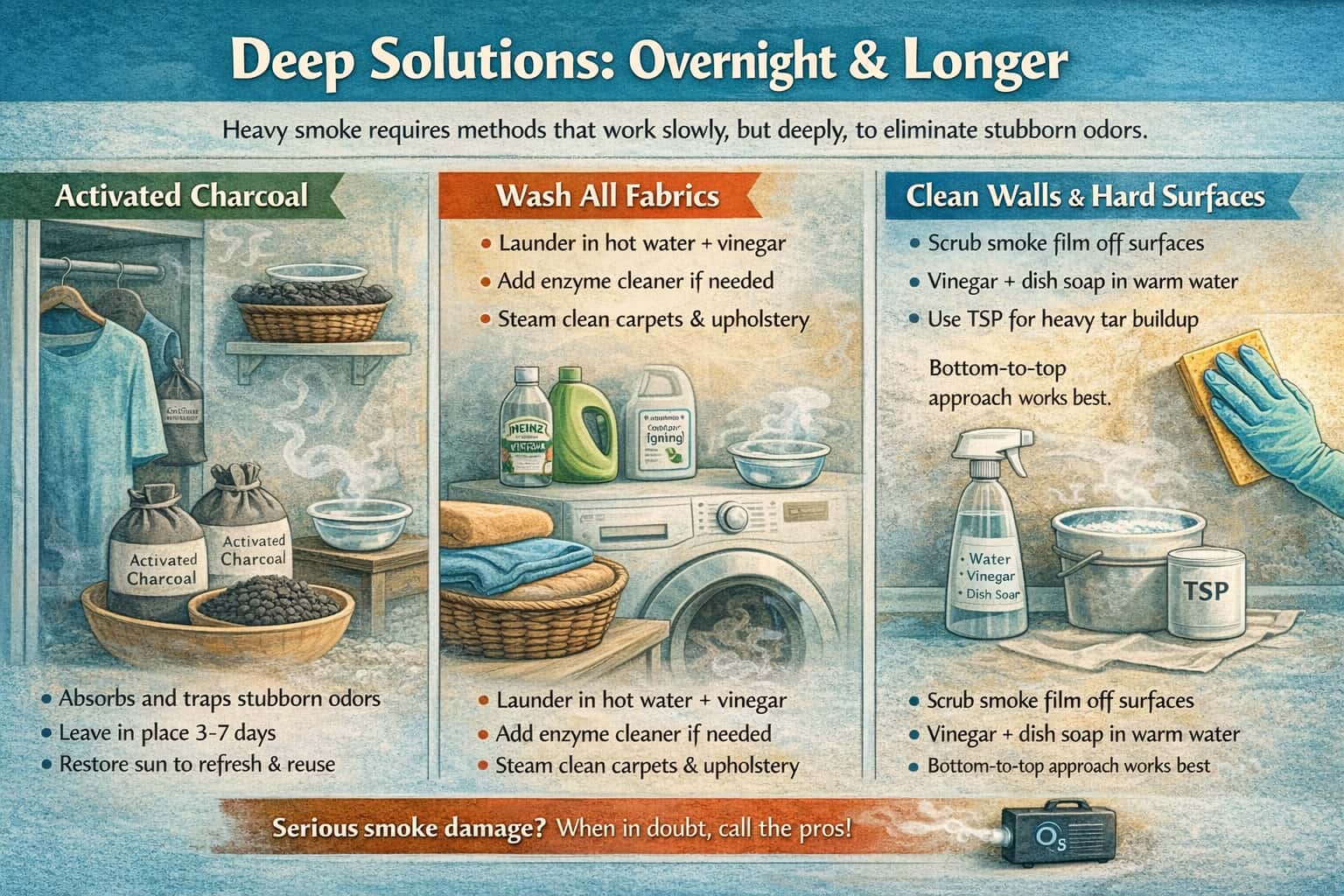 Activated Charcoal for Stubborn Odors
Activated charcoal outperforms baking soda for serious smoke contamination. The activation process creates millions of tiny pores that trap odor molecules through adsorption - the compounds physically bind to the charcoal surface rather than just sitting nearby.
Place charcoal bags or bowls of loose activated charcoal around the affected room. Focus on corners, closets, and areas with poor air circulation where smoke particles settle and concentrate. Leave them in place for 2-3 days minimum. For severe contamination, a full week makes a noticeable difference.
Unlike baking soda, activated charcoal is reusable. Set the bags in direct sunlight for 3-4 hours every few weeks - UV exposure releases trapped compounds and restores absorbing capacity. One set of charcoal bags can last 1-2 years with proper maintenance.
Where charcoal works best: Enclosed spaces magnify its effectiveness. Closets, drawers, storage boxes, and car interiors see faster results than open rooms. For a cigarette smell that won't leave your car, place charcoal bags under seats and in the trunk for a week.
Washing Everything Fabric
Smoke residue clings to fabric fibers and re-releases odors for months. The only permanent fix is removing that residue physically through washing.
Start with the obvious items - curtains, throw pillow covers, blankets, bedding. Wash in the hottest water the fabric allows with your regular detergent plus one cup of white vinegar in the rinse cycle. The vinegar cuts through residue that detergent alone misses.
For items that can't go in the washing machine, steam cleaning penetrates fibers and loosens embedded particles. Rental steam cleaners from hardware stores handle couches, mattresses, and wall-to-wall carpet. Go slowly - multiple passes work better than rushing through.
The stubborn smell test: If items still smell after washing, don't dry them with heat. Heat sets remaining odors permanently. Instead, air dry and wash again with an enzyme-based cleaner or odor-eliminating laundry additive. These break down organic compounds rather than just rinsing them away.
Cleaning Walls, Ceilings, and Hard Surfaces
Smoke creates an invisible film on every hard surface in a room. That yellowing you see on a longtime smoker's walls? The same residue exists everywhere, just thinner.
Mix a cleaning solution: one gallon of warm water, half a cup of white vinegar, a quarter cup of dish soap. For heavy tar buildup, substitute TSP (trisodium phosphate) for the dish soap - it cuts through nicotine residue more aggressively but requires gloves and ventilation.
Wash walls from bottom to top. This sounds counterintuitive, but drips running down a dirty wall create streaks that are harder to remove than the original film. Work in sections, rinse your sponge or cloth frequently, and change the cleaning solution once it turns yellow.
Don't skip the ceiling. Smoke rises, so ceilings often hold more residue than walls. Same cleaning method, but expect more dripping. Lay drop cloths and wear eye protection.
After the walls dry completely, consider repainting with an odor-sealing primer like Kilz or Zinsser. Standard paint allows residue to bleed through over time. Shellac-based primers create a true barrier.
 When to Call Professionals
Some smoke damage exceeds what DIY methods can fix. Fires, years of heavy indoor smoking, or smoke that's penetrated into wall cavities and HVAC ductwork may require professional remediation.
Ozone treatment is the most common professional approach. Ozone generators produce O3 molecules that break down odor compounds through oxidation. The process works, but requires vacating the space completely - ozone is harmful to breathe. Professionals run generators for 24-48 hours, then ventilate thoroughly before the space is habitable again.
Thermal fogging uses heated solvent to penetrate porous materials and neutralize embedded odors. It reaches places surface cleaning can't touch - inside wall cavities, deep in carpet padding, throughout HVAC ductwork.
Signs you need professional help:
- Smoke smell returns within days of thorough cleaning
- Visible staining that won't wash away
- Contamination from fire rather than cigarettes
- Odor present even after replacing carpet and repainting
Quick Comparison: Which Method Works for Your Situation
|
Method |
Time Needed |
Best For |
Limitations |
|
Cross-ventilation with fans |
15-20 min |
Fresh smoke, light contamination |
Weather dependent, doesn't remove embedded odors |
|
Boiling citrus/spices |
15-20 min |
Quick refresh before guests |
Temporary, masks more than removes |
|
Vinegar spray on fabrics |
10-15 min |
Surface odors on upholstery |
Won't reach deep fiber contamination |
|
Baking soda on surfaces |
2-4 hours |
Carpets, rugs, fabric furniture |
Requires thorough vacuuming after |
|
Vinegar bowls |
2-4 hours |
Airborne odor neutralization |
Room smells like vinegar during treatment |
|
Air purifier |
1-2 hours ongoing |
Continuous particle and VOC removal |
Requires proper filter types, ongoing filter cost |
|
Activated charcoal |
2-7 days |
Stubborn embedded odors, enclosed spaces |
Slow acting, needs periodic UV recharging |
|
Full fabric washing |
Half day |
Curtains, bedding, removable covers |
Can't wash everything, some items dry-clean only |
|
Wall and ceiling cleaning |
Full day |
Heavy tar residue, visible yellowing |
Labor intensive, may need repainting after |
|
Professional ozone treatment |
24-48 hours |
Severe contamination, fire damage |
Expensive, requires vacating the space |

.jpg?height=200&name=photo_2024-04-24_20-21-17%20(1).jpg)