























Your HVAC system runs at 2 AM, cooling empty offices. Lighting stays on in storage rooms no one enters for days. Duct leaks push conditioned air into ceiling voids. These invisible drains add up—commercial buildings typically waste 25-30% of the energy they purchase.
Improving energy efficiency in commercial buildings starts with finding these leaks, both literal and operational. The five strategies below target the highest-impact systems first, with documented payback periods and performance benchmarks from DOE and EPA research.
1. Upgrade to Smart Building Automation Systems
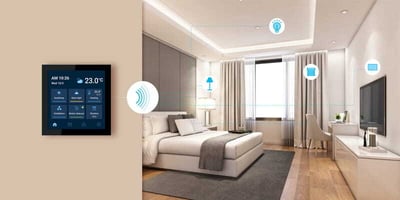
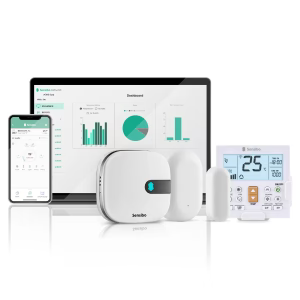
Building automation systems (BAS) serve as the central nervous system for commercial property energy management. These platforms connect lighting, HVAC, security, and other building systems into a unified network that can be monitored and adjusted from a single interface.
How BAS Reduces Energy Waste:
A properly configured BAS eliminates the inefficiencies that occur when building systems operate independently. Consider a common scenario: an HVAC system cooling a conference room while occupancy sensors indicate the space has been empty for hours. Without integration, this waste continues unnoticed.
Modern BAS platforms use real-time data from occupancy sensors, weather forecasts, and utility rate schedules to make automatic adjustments. The Lawrence Berkeley National Laboratory found that buildings with advanced automation systems achieve 10-25% energy savings compared to manually controlled buildings.
Implementation Considerations:
Start with an energy audit to identify which systems consume the most power and where automation will deliver the highest return. Newer buildings may already have BAS infrastructure that simply needs optimization, while older structures might require phased installation to manage costs.
The investment typically pays for itself within 2-5 years through utility savings, with additional benefits including extended equipment life and reduced maintenance costs.
2. Optimize HVAC Systems for Maximum Performance
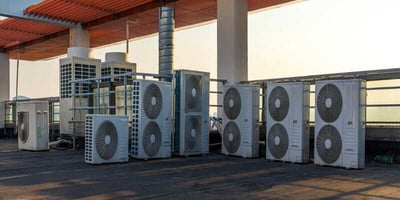
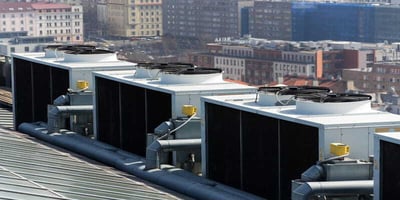
Heating, ventilation, and air conditioning systems consume roughly 40% of total energy in commercial buildings. This makes commercial HVAC energy efficiency the single most impactful target for reducing operating costs. A systematic approach to HVAC optimization addresses maintenance, equipment selection, and ventilation strategy as interconnected elements rather than isolated projects.
The Three-Tier Approach to HVAC Optimization
Tier 1: Maintenance Excellence
Neglected HVAC equipment works harder to achieve the same output, driving up energy consumption. A straightforward maintenance schedule should include:
- Replacing air filters every 1-3 months (dirty filters can increase energy use by 5-15%)
- Cleaning evaporator and condenser coils annually
- Checking refrigerant levels and fixing leaks promptly
- Calibrating thermostats and sensors quarterly
- Inspecting and sealing ductwork for leaks (typical duct systems lose 20-30% of conditioned air)
Tier 2: Equipment Upgrades
For systems older than 15 years, replacement often makes more financial sense than continued repairs. Modern HVAC units with variable-speed compressors and fans adjust output to match actual demand rather than cycling between full-on and full-off states. This variable operation can cut HVAC energy consumption by 25-50% compared to older fixed-speed equipment.
Tier 3: Demand-Controlled Ventilation
Traditional HVAC systems deliver the same amount of outside air regardless of occupancy levels. Demand-controlled ventilation (DCV) uses CO2 sensors to measure actual occupancy and adjusts fresh air intake accordingly. In spaces with variable occupancy like conference rooms, auditoriums, or retail floors, DCV systems can reduce ventilation energy by 20-30%.
3. Implement Strategic Lighting Retrofits
 Lighting accounts for approximately 17% of electricity use in commercial buildings, making it the second-largest energy consumer after HVAC. Unlike complex mechanical systems, lighting upgrades offer relatively simple installation with predictable results.
|
Lighting Technology |
Watts per 1000 Lumens |
Lifespan (Hours) |
Annual Savings vs. Incandescent |
|
Incandescent |
60W |
1,000 |
Baseline |
|
CFL |
15W |
8,000 |
$50-70 per fixture |
|
LED |
8-10W |
25,000-50,000 |
$80-100 per fixture |
Beyond Bulb Replacement
Simply swapping fixtures captures only part of the available savings. A complete lighting strategy for reducing energy consumption in commercial buildings should address:
Daylighting Integration: Light sensors near windows automatically dim artificial lighting when natural light is sufficient. Buildings with proper daylighting controls reduce lighting electricity use by 35-60% in perimeter zones.
Task Lighting: Providing adjustable desk lamps allows lower ambient light levels while maintaining adequate illumination where work actually happens. This approach can reduce overall lighting power density by 20-30%.
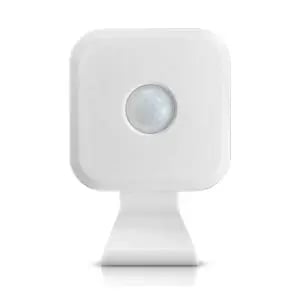
Occupancy Controls: Motion sensors in private offices, restrooms, storage rooms, and break areas eliminate "always-on" waste. The Illuminating Engineering Society estimates occupancy sensors reduce lighting energy by 24-90% depending on space type and usage patterns.
Color Temperature Selection: LED fixtures allow precise control over color temperature (measured in Kelvin). For offices, 4000-5000K provides bright, focused light that supports productivity. Retail environments often benefit from warmer 3000K lighting that enhances product appearance. Selecting appropriate color temperatures reduces the temptation to over-light spaces, contributing to reducing energy consumption in commercial buildings.
4. Enhance Building Envelope Performance
The building envelope—walls, roof, windows, and foundation—determines how much energy is required to maintain comfortable indoor conditions. Poor insulation and air leaks force HVAC systems to work overtime compensating for thermal losses.
Identifying Envelope Weaknesses
Infrared thermography provides a visual map of where buildings lose energy. During a thermal scan, insulation gaps, air leaks around windows and doors, and thermal bridges through structural elements appear as distinct hot or cold spots. Many utility companies offer free or subsidized thermal assessments for commercial customers.
High-Impact Envelope Improvements
Window Upgrades: Single-pane windows offer R-values (thermal resistance) of about R-1, while modern double-pane low-E windows achieve R-3 to R-4. In climates with extreme temperatures, windows can account for 25-30% of a building's heating and cooling load.
Roof Improvements: For buildings with flat roofs, adding a reflective "cool roof" coating reduces solar heat gain during summer months. The Cool Roof Rating Council reports that cool roofs can lower roof surface temperatures by up to 50°F, translating to 7-15% cooling energy savings.
Air Sealing: Before adding insulation, sealing air leaks delivers immediate returns. Common leak points include:
- Gaps around pipe and wire penetrations
- Loading dock doors and seals
- Window and door frames
- Joints between walls and floors or ceilings
Professional air sealing in commercial buildings typically costs $0.50-2.00 per square foot and reduces heating and cooling energy by 10-20%.
Insulation Upgrades: Adding insulation to walls and roofs offers diminishing returns beyond certain R-values, which vary by climate zone. The Department of Energy provides recommended R-values by region—ranging from R-30 to R-60 for attics in colder climates. Calculating the optimal insulation level requires balancing installation costs against projected energy savings over the building's remaining useful life.
5. Establish Data-Driven Energy Monitoring
You cannot manage what you do not measure. Systematic energy monitoring forms the foundation of effective commercial property energy management, revealing exactly where energy goes and identifying opportunities for improvement.
 Building an Energy Monitoring Framework
Step 1: Submetering Installation
Whole-building utility meters show total consumption but provide no insight into which systems or areas drive that usage. Submeters on major equipment (HVAC units, data centers, kitchen equipment, production machinery) and tenant spaces allow granular tracking.
Step 2: Data Collection and Benchmarking
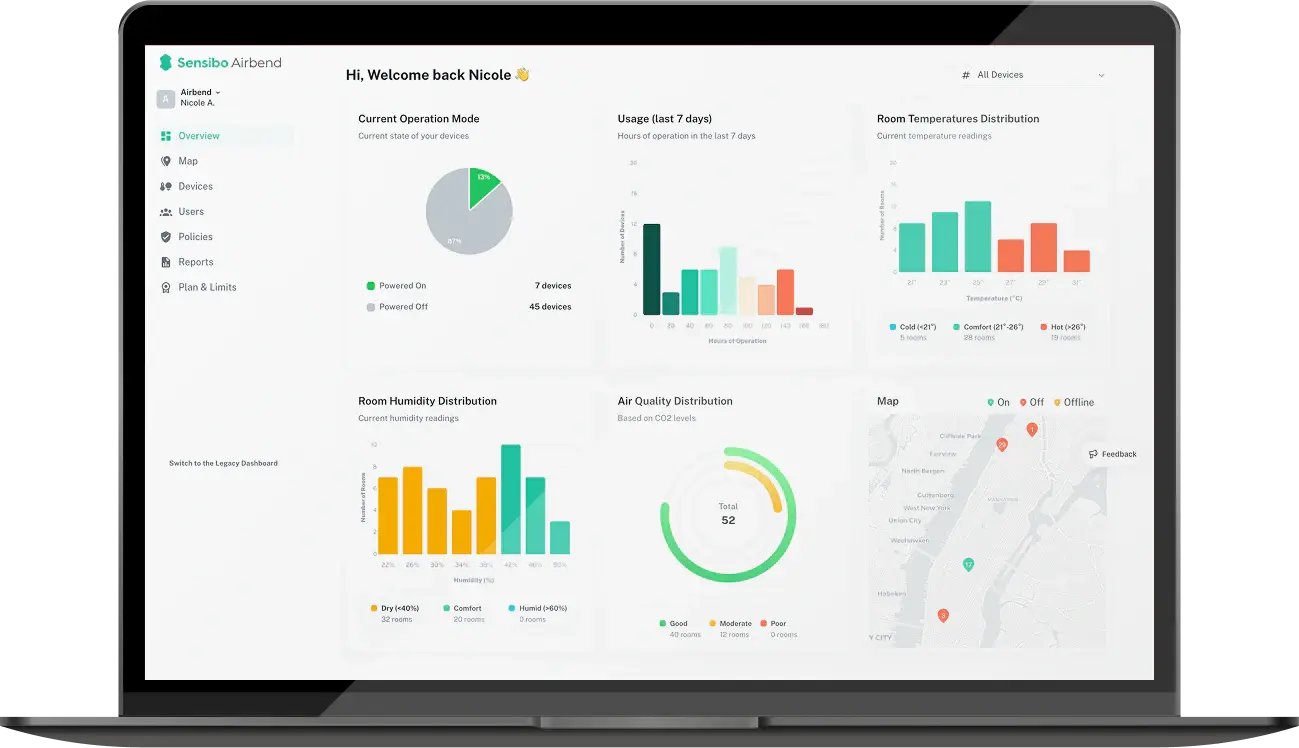
Energy Star Portfolio Manager, a free tool from the EPA, allows building managers to track energy use intensity (EUI) measured in kBtu per square foot per year. Comparing your building's EUI against similar properties nationwide reveals how much room exists for improvement.
The median EUI for U.S. office buildings is approximately 93 kBtu/sf/year. Buildings scoring in the top 25% typically achieve EUI values below 70 kBtu/sf/year.
Step 3: Continuous Commissioning
Energy monitoring should drive ongoing adjustments, not just annual reports. Continuous commissioning—regularly reviewing performance data and fine-tuning systems—captures savings that erode over time as schedules drift, sensors lose calibration, and occupancy patterns change.
Buildings that practice continuous commissioning maintain 5-15% better energy performance compared to buildings that only commission systems at installation.
Real-Time Dashboards
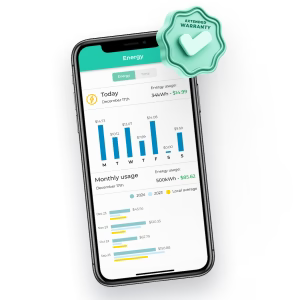
Making energy data visible to building occupants and tenants encourages conservation behavior. Lobby displays showing real-time energy use and monthly trends create awareness and social motivation. Research from the Pacific Northwest National Laboratory found that visible energy dashboards reduce consumption by 5-10% through behavioral changes alone.
Tenant Engagement Programs
For multi-tenant buildings, structured engagement programs amplify monitoring benefits. Monthly reports comparing each tenant's energy use against building averages create healthy competition. Some property managers offer incentives—reduced common area charges or recognition programs—for tenants who achieve efficiency targets. These programs work because they translate abstract data into tangible consequences.
The Bottom Line on Building Energy
Commercial building energy efficiency improvements deliver compound returns: lower utility bills, reduced maintenance costs, increased tenant satisfaction, and stronger property values. Start with an energy audit to prioritize projects by payback period, then work systematically through high-impact upgrades. The buildings achieving the best results treat energy efficiency in commercial buildings as an ongoing process rather than a one-time project—continuously measuring, adjusting, and improving.